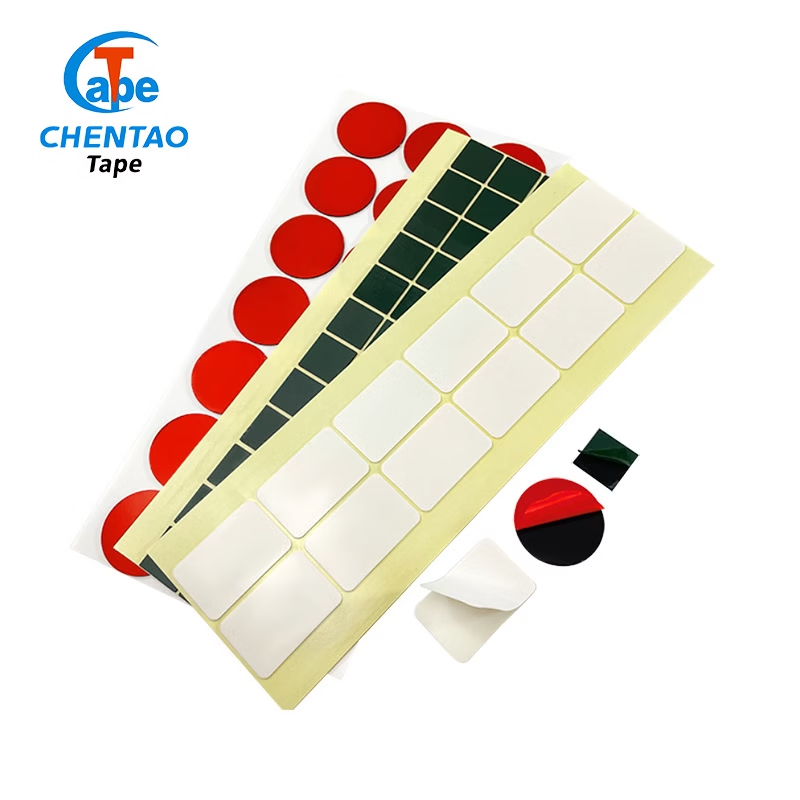
Polyimide Tape: Complete Engineering Guide (2026)
- Compare polyimide tape grades, adhesive systems and common applications.
- Use the selection and supplier checklists to prepare your specification.
- Confirm the chosen grade on your actual parts and process.
On this page
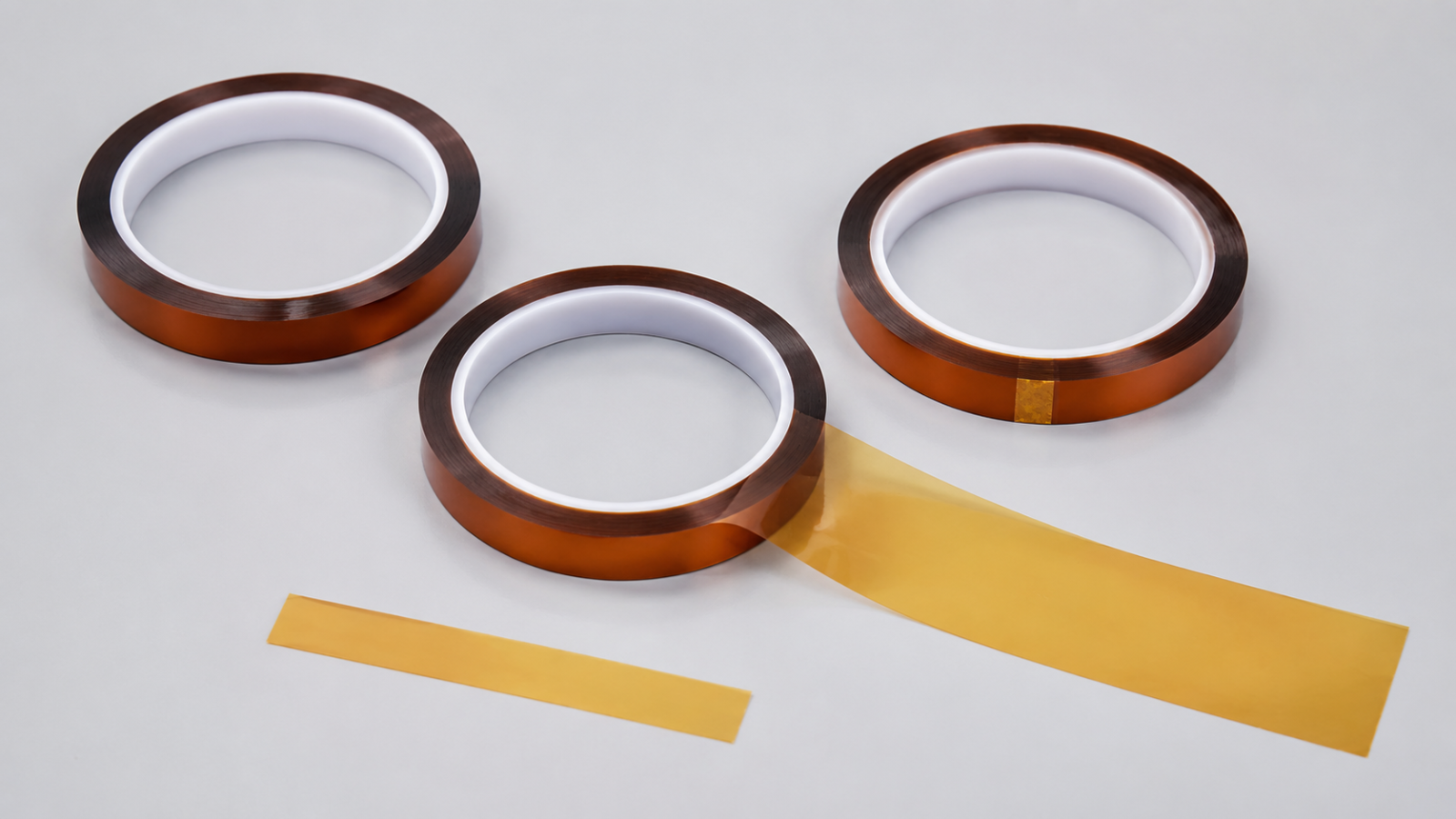
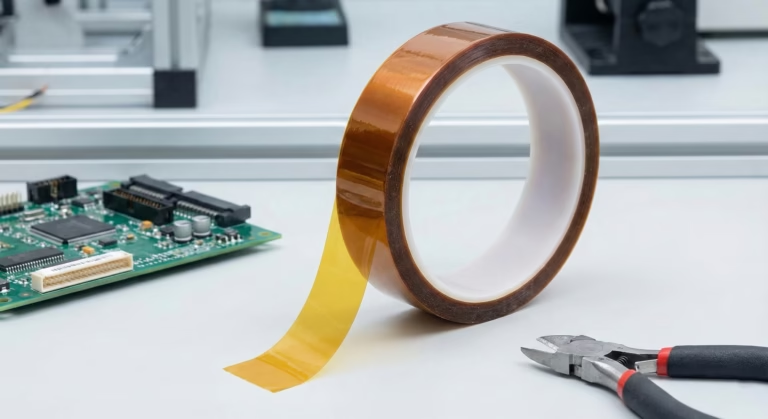
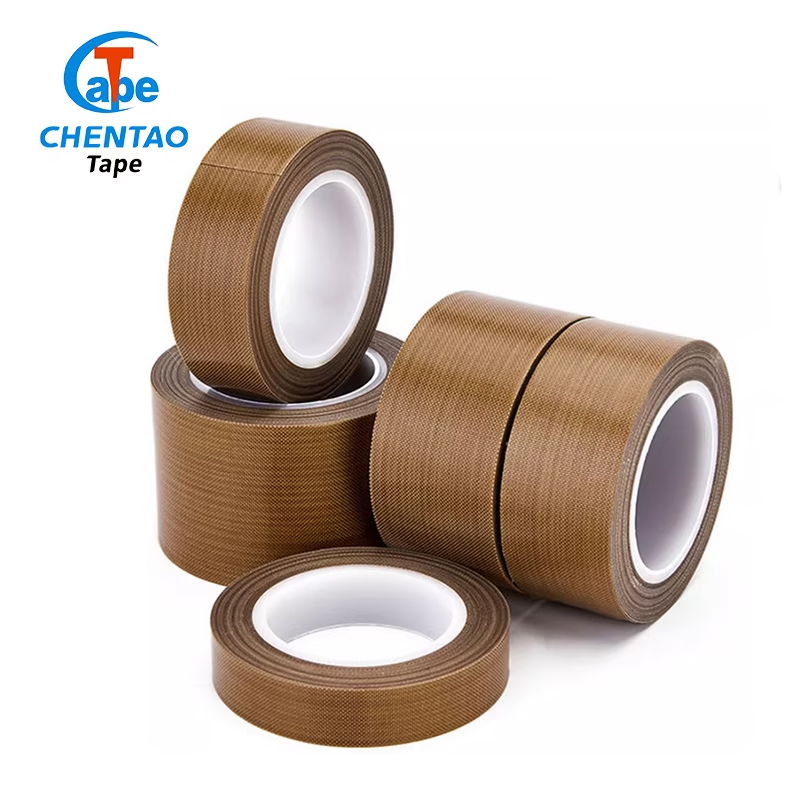
Polyimide (PI) tape is an amber-colored pressure-sensitive film combining an aromatic polyimide substrate with a silicone or acrylic adhesive, engineered for continuous service at 260°C where PET-based tapes fail. This guide covers the material science, adhesive chemistry, standard grades, selection criteria, and industrial applications of polyimide tape — with dedicated depth articles on SMT masking, motor insulation, aerospace certification, die-cut formats, and high-temperature applications linked throughout.
What Is Polyimide Tape?
Polyimide Film Substrate
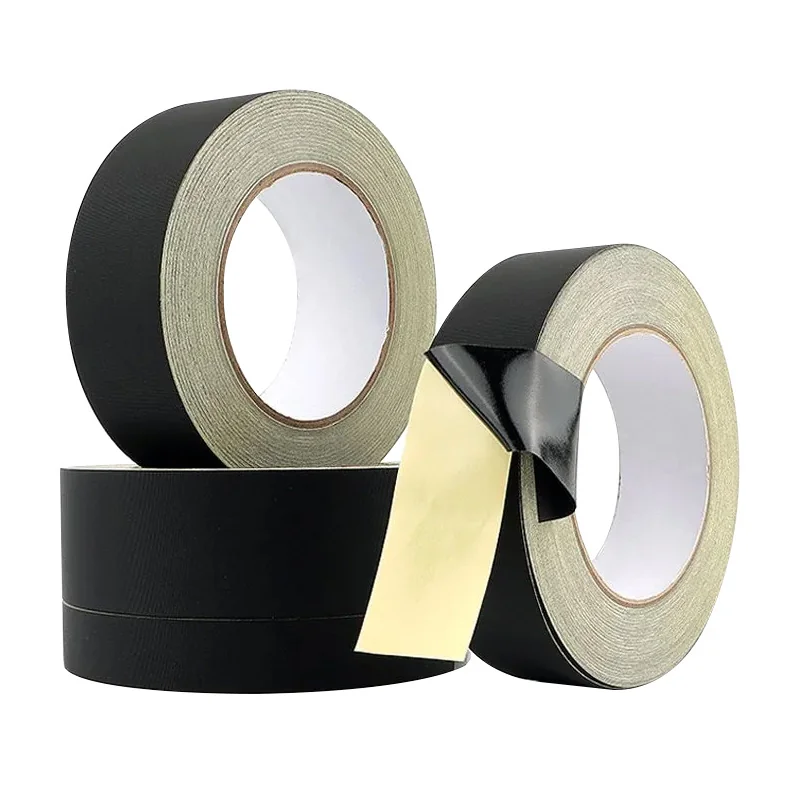
Aromatic polyimide polymer is formed by condensation of dianhydride and diamine monomers, closing an imide ring that confers exceptional thermal and electrical stability. The resulting film is translucent amber — the characteristic color of the aromatic ring system, which also provides inherent UV absorption at wavelengths below 400 nm. Black variants, carbon-doped to opacity, serve laser-printable labeling and light-blocking applications in flat panel display assembly.
Standard film thicknesses range from 12.5 μm to 125 μm, with 25 μm and 50 μm covering the majority of industrial volume. Key substrate properties at room temperature:
Scroll sideways to compare all columns.
| Property | Value | Test method |
|---|---|---|
| Continuous service temperature | 260°C | UL 746B / IEC 60216 |
| Short-term peak tolerance | 400°C | — |
| Tensile strength | ≥ 170 N/25 mm | ASTM D882 |
| Elongation at break | ≥ 50% | ASTM D882 |
| Volume resistivity | 10¹⁶ Ω·cm | ASTM D257 |
| Coefficient of thermal expansion | ~20 ppm/°C | — |
Versus comparable high-temperature films: PET reaches a continuous service ceiling of 150°C with a CTE of approximately 60 ppm/°C, making it unsuitable for lead-free reflow. PTFE film matches the 260°C thermal ceiling but at a lower modulus and 2–5× the cost per square metre. Polyimide is the primary specification where thermal stability, mechanical strength, and dielectric performance must be combined in a single adhesive tape.
Adhesive Systems: Silicone vs. Acrylic
Two adhesive chemistries define the commercial polyimide tape market:
Silicone PSA: maintains bond integrity through the full 260°C service range with near-zero adhesive transfer to contact surfaces. The cross-linked silicone network neither flows nor degrades at lead-free reflow temperatures, leaving gold-finger connectors, copper pads, and motor winding surfaces clean after removal. Higher cost than acrylic, but the required specification for precision electronics and Class H insulation systems.
Acrylic PSA: continuous service to approximately 180°C, with short-term excursion tolerance to ~220°C. Higher initial tack and lower material cost make it suitable for general-purpose masking below 180°C. Above 120°C, acrylic adhesive softens; removal from precision electrical surfaces risks adhesive transfer. Not recommended for gold contacts, motor windings, or any substrate where contamination cannot be tolerated.
Selection rule: specify silicone-adhesive grades for SMT reflow masking, gold-plated contacts, motor coil winding (including VPI process compatibility), and any application where the substrate cannot accept adhesive contamination. Acrylic-adhesive grades are cost-justified for general protective masking below 180°C.
Standard Construction Parameters
Finished tape construction (film plus adhesive) spans 50 μm to 200 μm in combined thickness. Standard slit roll widths range from 3 mm to 500 mm; custom widths and traverse winding formats are available from tape converters. Adhesive coat weight ranges from 20 μm to 50 μm — thicker coats increase initial peel strength but may elevate residue risk on extended high-temperature dwell above 150°C.
Key Engineering Properties
Thermal Performance
Continuous service at 260°C per UL 746B and IEC 60216, with short-term peak excursion tolerance up to 400°C. At rated temperature, polyimide tape exhibits no dimensional creep, no adhesive migration, and no softening of the film substrate — the three failure modes that disqualify PET tape from SMT reflow and motor insulation duty. The table below compares high-temperature tape materials across critical parameters:
Scroll sideways to compare all columns.
| Material | Continuous service | CTE (ppm/°C) | Tensile modulus | Cost index |
|---|---|---|---|---|
| Polyimide (PI) | 260°C | ~20 | High | Medium–High |
| PET | 150°C | ~60 | Medium | Low |
| PTFE | 260°C | ~100 | Low | High |
| Glass cloth tape | 300°C+ | ~5 | High | Medium |
Dielectric Properties
Dielectric strength at 25 μm film thickness measures 5,000–7,000 V per ASTM D149, exceeding PET tape by 40–100% at equivalent gauge. Volume resistivity of 10¹⁶ Ω·cm (ASTM D257) supports use as inter-layer insulation in power transformers, motor slot liners, and high-voltage cable repair wraps.
IEC 60085 insulation class assignments relevant to polyimide tape:
- Class H (180°C): standard silicone-adhesive polyimide — baseline specification for EV traction motor stator windings and industrial transformer insulation
- Class C (>220°C): high-temperature silicone variants — applied in aerospace avionics harnesses and generator rewinding where sustained winding temperatures exceed 200°C
Chemical and Solvent Resistance
Polyimide film resists rosin flux, isopropyl alcohol, ketones, dilute acids, and most organic solvents encountered in electronics assembly and harness manufacturing. The primary limitation is sustained exposure to strong alkaline solutions (NaOH, KOH above low concentrations), which accelerate imide ring hydrolysis and degrade mechanical properties. PTFE film offers broader chemical resistance — including alkali tolerance — at a cost and modulus penalty. For applications involving repeated alkaline cleaning steps, PTFE or glass cloth tape is the appropriate choice.
Dimensional Stability
A CTE of approximately 20 ppm/°C (versus ~60 ppm/°C for PET) prevents lifting, curling, or flagging at PCB board edges during conveyor transport through reflow ovens. Tensile strength retention at operating temperature enables automated coil-winding operations where the tape must withstand machine-speed tensioning without elongation-induced positional drift. This dimensional stability is the property that makes polyimide tape the standard material for fine-pitch BGA masking, where any tape movement during reflow causes bridging or void defects.
Standard Grades and Specifications
Grade Selection Table
Scroll sideways to compare all columns.
| Grade | Film thickness | Adhesive | Continuous temp | Primary applications |
|---|---|---|---|---|
| CT-PI-12.5S | 12.5 μm | Silicone | 260°C | Fine-pitch BGA masking, flex circuit overlay |
| CT-PI-25S | 25 μm | Silicone | 260°C | PCB reflow masking, standard insulation |
| CT-PI-50S | 50 μm | Silicone | 260°C | Motor winding, through-hole plug masking |
| CT-PI-75S | 75 μm | Silicone | 260°C | Harness wrapping, slot liner blanks |
| CT-PI-25A | 25 μm | Acrylic | 180°C | General masking below 180°C |
| CT-PI-50A | 50 μm | Acrylic | 180°C | Cost-sensitive PCB masking |
For complete peel-force curves, dielectric strength values by thickness, and guidance on reading COA data for incoming inspection, see the Polyimide Tape Datasheet: Engineering Guide to Key Specs.
Test Methods and Certifications
- Mechanical: ASTM D882 (tensile strength and elongation at break), ASTM D374 (tape thickness), ASTM D3330 (180° peel adhesion)
- Electrical: ASTM D149 (dielectric strength), ASTM D257 (volume and surface resistivity)
- Thermal: UL 746B (relative thermal index), IEC 60085 (insulation class qualification)
- Compliance: RoHS 2.0 (six restricted substances), REACH SVHC compliance, halogen-free certification available on request
- Lot traceability: Certificate of analysis (COA) per lot number, including raw material batch, test data, and production date — standard requirement for aerospace and EV battery programs
Applications by Industry
PCB and SMT Manufacturing
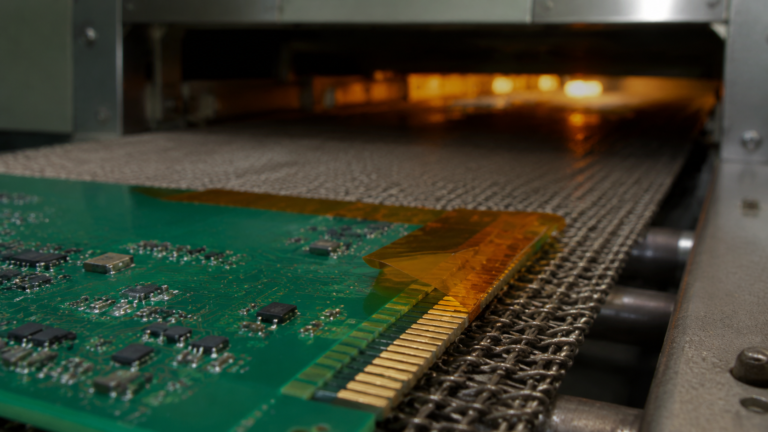
Lead-free solder (SAC305) reflow profiles hold 260°C for 30–60 seconds across the peak dwell zone. Standard PET tape — rated to 150°C — deforms, lifts, and transfers adhesive to copper pads at these temperatures. Silicone-adhesive polyimide tape holds the full reflow profile without dimensional change, leaving no residue on gold-finger connectors, via pads, or SMD component footprints.
Process parameters by pad geometry:
- 25 μm silicone: ≤0.3 mm pitch BGA masking; zero-residue protection for gold-plated connectors
- 50 μm silicone: through-hole plug masking, wave solder dam application (bath temperature 260°C, dwell 3–10 s)
- Removal protocol: within 30 minutes of cooling below 40°C to minimise residue risk on all substrate types
Established industrial benchmarks in the 25 μm silicone-adhesive class include Nitto No.360 and comparable grades from major tape converters. A 25 μm silicone-adhesive grade — whether Nitto, or an equivalent industrial specification meeting IPC-4202A flexible base dielectric requirements — delivers equivalent clean-release performance across SAC305 and lead-free wave solder profiles.
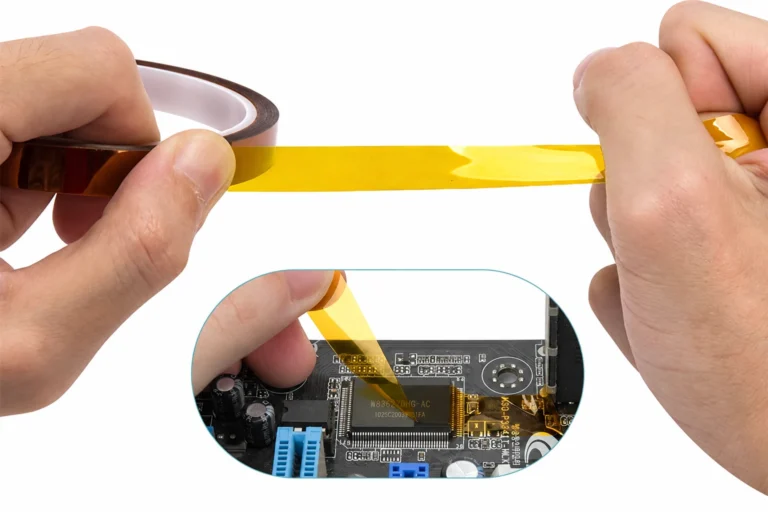
For step-by-step masking technique, dwell-time tables, and removal procedures, see How to Use Polyimide Tape for Masking.
Electric Motor and Transformer Insulation
EV traction motor stator coils reach 180–220°C at peak torque; PHEV generator windings spike to 240°C during regenerative braking events. Both operating windows require IEC 60085 Class H or Class C insulation system qualification — a threshold acrylic-adhesive tapes cannot meet.
Established thermal insulation benchmarks in this segment include DuPont’s high-temperature polyimide film systems widely specified in legacy aerospace and high-output traction motor designs, and Tesa 51408, the European automotive benchmark for Class H coil wrapping. Silicone-adhesive polyimide tape in the 50–75 μm range meets the same IEC 60085 Class H rating with lower material weight, simpler automated winding-head compatibility, and full VPI (vacuum pressure impregnation) process compatibility — silicone adhesive does not outgas during impregnation cycles, unlike certain acrylic systems.
Standard slit widths for coil winding run from 3 mm to 50 mm; die-cut blanks cover slot liner and end-winding separator applications.
Aerospace and Defense
Wire harness wrapping in avionics assemblies requires low-outgassing per NASA/ESA ASTM E595 standards and conformance to MIL-W-22759 wire characteristics. Polyimide tape satisfies both: the film substrate’s inherently low vapour pressure at operating temperature produces negligible outgassing in vacuum environments, and the amber film withstands the flex cycling and vibration loads typical of airframe wiring bundles.
AS9100D supplier qualification for aerospace programs requires lot-level COA, full material traceability from raw film through finished tape, and in-house test capability verification by an independent audit. For AS9100D documentation requirements and MIL-spec qualification procedures, see Aerospace-grade Polyimide Tape: Certifications and Traceability.
Automotive and EV Powertrain
E-coat paint bake masking requires protection at 180–200°C for 20–40 minutes across body-in-white and powertrain components. Acrylic-adhesive polyimide tape covers this temperature range at lower cost than silicone grades while maintaining clean-release performance. For EV battery pack wiring routed near power electronics, silicone-adhesive grades rated to 260°C provide the thermal protection margin required by the operating environment.
Black polyimide grades with laser-printable topcoat enable direct wire bundle identification and barcode marking on the tape surface, replacing separate heat-shrink label sleeves in high-density harness assemblies.
Semiconductor and Flat Panel Display
Wafer-level packaging and dicing tape backing applications require dimensional stability through photolithography thermal cycles and low particle shedding during singulation. Polyimide film’s low CTE maintains positioning accuracy through elevated-temperature deposition steps. In flat panel display backplane assembly, polyimide tape supports amorphous silicon TFT array handling through temperature steps that would cause PET film to deform and generate alignment errors.
Selecting the Right Grade
Temperature Range Decision Tree
- Below 150°C: PET masking tape — lowest cost, adequate performance
- 150–180°C: acrylic-adhesive polyimide — cost advantage over silicone; suitable for e-coat masking and general elevated-temperature protection
- 180–260°C: silicone-adhesive polyimide — primary industrial specification for SMT reflow, motor insulation, Class H and Class C applications
- Above 260°C continuous: PTFE tape, glass cloth tape, or mica-tape insulation systems
- Wide thermal cycling (−269°C to +260°C): polyimide film retains mechanical integrity across cryogenic and high-temperature extremes, the specification for satellite and space applications
Film Thickness Selection
- 12.5–25 μm: fine-pitch BGA masking, flexible circuit overlay — maximum conformability to irregular pad geometries
- 50 μm: general PCB reflow masking, standard motor coil insulation — dominant commercial specification covering most applications
- 75–125 μm: heavy motor slot liner, aerospace harness wrapping, applications requiring maximum mechanical durability
Above 75 μm, conformability decreases measurably. Verify minimum bend radius against application geometry before specifying; high-speed coil winding on small-diameter mandrels requires confirming that the tape does not crack under the winding tension and radius combination.
When Polyimide Tape Is Not the Right Choice
- Prolonged alkaline exposure: sustained NaOH or KOH contact above low concentrations hydrolyzes the imide ring — specify PTFE or glass cloth tape instead
- Outdoor or UV-intensive environments: polyimide film yellows and embrittles under extended ultraviolet exposure — specify UV-stable PTFE or polyolefin alternatives
- Above 260°C continuous: PTFE (up to 260°C continuous, 300°C intermittent) or mica tape (up to 400°C+) are the appropriate choices
- Cost-sensitive applications below 150°C: standard PET masking tape costs a fraction of polyimide per linear metre for applications where the temperature ceiling is not approached
Polyimide Tape vs. Alternatives
Scroll sideways to compare all columns.
| Property | Polyimide (PI) | PET | PTFE | Glass cloth |
|---|---|---|---|---|
| Continuous service | 260°C | 150°C | 260°C | 300°C+ |
| Dielectric strength | 5,000–7,000 V | 3,000–5,000 V | 4,000–6,000 V | 500–1,500 V |
| CTE (ppm/°C) | ~20 | ~60 | ~100 | ~5 |
| Cost index | Medium–High | Low | High | Medium |
| Clean release at temperature | Excellent (silicone) | Marginal above 120°C | Excellent | Weave imprint risk |
| Tensile strength | High | Medium | Low | High |
Choose PTFE when chemical resistance (particularly alkali tolerance) or continuous service above 260°C is required and cost premium is acceptable. Choose glass cloth for applications above 300°C or where the mechanical reinforcement of the insulation layer is prioritised over conformability. Choose PET for masking applications below 150°C where cost is the primary driver and residue risk at temperature is not a concern.
Die-Cut and Custom Configurations
Die-cut polyimide tape enables precise coverage of specific PCB pad geometries, connector lead frames, and motor slot profiles that roll-format tape cannot mask cleanly in production volumes.
Dimensional tolerances by cut type:
- Steel-rule die: ±0.1 mm — suitable for discrete pad protection and standard connector masking in medium-volume production
- Laser cutting: ±0.05 mm — for fine-pitch BGA pads, complex lead frame masks, and high-density FPC overlay shapes where positional accuracy is critical
Liner options: silicone release liner for manual application and peel-and-place workflows; PET-backed liner for high-speed automated dispensing and pick-and-place equipment compatibility.
For full die-cut format options, MOQ structures, and tolerance comparison by cut method, see Die Cut Polyimide Tape: Benefits, Applications, and Buying Guide. Custom slit widths and specialised reel formats — including traverse winding for automated winding-machine feeding — are covered in Polyimide Tape: Custom Manufacturing Solutions.
Supplier Evaluation and Quality Standards
Selecting a polyimide tape source for a production program requires verifying quality systems, in-house test capabilities, and traceability documentation before supplier approval:
- Quality system certification: ISO 9001:2015 minimum; IATF 16949 for automotive supply; AS9100D for aerospace programs
- Film sourcing transparency: confirm whether PI film is self-manufactured or externally sourced — self-manufacture enables tighter lot-to-lot consistency and faster response to specification changes
- In-house test capabilities: verify the supplier can perform ASTM D882, D149, and D3330 with traceable test equipment and issue COA data per lot
- Lot traceability: COA with lot number, raw material batch, test data, and production date — mandatory for aerospace and EV battery pack qualification programs
- Lead time by format: standard slit rolls (5–7 business days), custom slit widths (10–15 days), die-cut shapes (15–20 days depending on tooling availability)
ChenTao operates an ISO 9001:2015-certified manufacturing facility in Dongguan and provides full lot-level COA documentation for standard and custom polyimide tape grades. Standard grades ship within 24 hours for sample quantities. To request a quote or review product specifications, please contact us with your application requirements.
Related Engineering Guides
This hub article connects six depth resources covering specific polyimide tape applications, test data, and configuration options:
Scroll sideways to compare all columns.
| Article | Focus area |
|---|---|
| Polyimide Tape Datasheet: Engineering Guide to Key Specs | Full specification tables, COA interpretation, incoming inspection test methods |
| How to Use Polyimide Tape for Masking | Step-by-step masking technique, process parameters, removal procedures |
| Die Cut Polyimide Tape: Benefits, Applications, and Buying Guide | Custom shapes, dimensional tolerances, liner selection |
| Aerospace-grade Polyimide Tape: Certifications and Traceability | MIL-spec, AS9100D, lot traceability documentation standards |
| Polyimide Tape: Custom Manufacturing Solutions | Custom slit widths, die-cut shapes, reel winding formats |
| High-Temperature Polyimide Tape Applications | PCB, EV motor, and aerospace depth-dive application guides |
Frequently Asked Questions
What is the maximum service temperature for polyimide tape?
Polyimide tape with silicone adhesive is rated for continuous service at 260°C per UL 746B and IEC 60216, with short-term peak excursion tolerance up to 400°C. Acrylic-adhesive variants carry a continuous service rating of approximately 180°C, with short-term tolerance to around 220°C. For IEC 60085 insulation class purposes: standard silicone-adhesive polyimide qualifies as Class H (180°C); high-temperature silicone variants achieve Class C (above 220°C), required for aerospace avionics harnesses and high-performance generator rewinding.
How does polyimide tape differ from standard masking tape in high-heat processes?
The distinction lies in substrate and adhesive chemistry. Standard masking tape uses a paper or PET film substrate with rubber or acrylic adhesive — both fail structurally below 180°C. Polyimide tape uses an aromatic polyimide film substrate rated to 260°C continuous, with silicone PSA that maintains adhesion and releases cleanly at full rated temperature. The practical outcome: polyimide tape completes SAC305 lead-free reflow profiles without lifting, warping, or transferring adhesive to solder pads. Industrial benchmarks in the 25 μm silicone-adhesive class — including Nitto No.360 and comparable grades — set the reference for clean-release performance in this temperature range.
Does polyimide tape leave adhesive residue after removal?
Silicone PSA on polyimide tape leaves near-zero adhesive transfer to surfaces when removed within the process specification window — typically within 30 minutes of cooling below 40°C in SMT applications. Residue risk increases with extended dwell time above 150°C and on porous or rough substrates where adhesive penetration increases. Acrylic-adhesive grades are more prone to residue transfer when exposed above 120°C and should not be used on precision electronic contact surfaces. Verify residue performance on your specific substrate before full-scale production deployment.
What specifications are required for PCB wave solder masking?
For wave solder applications (bath temperature 260°C, dwell 3–10 seconds): 25 μm silicone-adhesive polyimide tape meeting ASTM D3330 peel strength 8–14 N/25 mm and IPC-4202A flexible base dielectric compliance. Zero residue on gold-finger contacts and copper pads per IPC-A-610 workmanship requirements. Apply flat to the board with no air pockets; remove within 30 minutes of cooling below 40°C. For SMT reflow (260°C, 30–60 second dwell), the same 25 μm silicone grade applies; 50 μm silicone is preferred for through-hole plug masking and wave solder dam configurations.
How thick should polyimide tape be for electric motor slot insulation?
For IEC 60085 Class H applications (continuous winding temperature up to 180°C): 50–75 μm silicone-adhesive polyimide tape is the standard specification. For Class C applications (above 220°C, as in aerospace generator rewinding and high-output EV traction motors): 75–125 μm provides the additional dielectric margin and mechanical robustness required by the insulation system. Width selection: 3–50 mm slit rolls for coil wrapping; wider pre-slit or die-cut blanks for slot liner and end-winding separator formats. Established DuPont and Tesa high-temperature insulation systems occupy the same Class H performance window and serve as benchmarks for comparison during material qualification.
What lead times and sample options are available for polyimide tape?
Standard polyimide tape grades ship within 24 hours for sample quantities. Custom slit widths carry a 5–7 business day lead time; die-cut shapes require 15–20 days depending on tooling availability. Full certificate of analysis per lot is standard for aerospace and EV battery qualification programs. Request samples or a custom quote — specify application temperature, substrate material, and required tape width.
Find the right tape for your application
Tell us what you need to bond, your operating conditions and the size or quantity you have in mind. Our team can help with material selection, samples and a quotation.
Discuss my application