High-Temperature Polyimide Tape: 5 Ultimate Applications
Polyimide tape for high-temperature applications: 260°C continuous service, IEC 60216, Class H. PCB reflow, EV motors, aerospace. Request free samples.
On this page
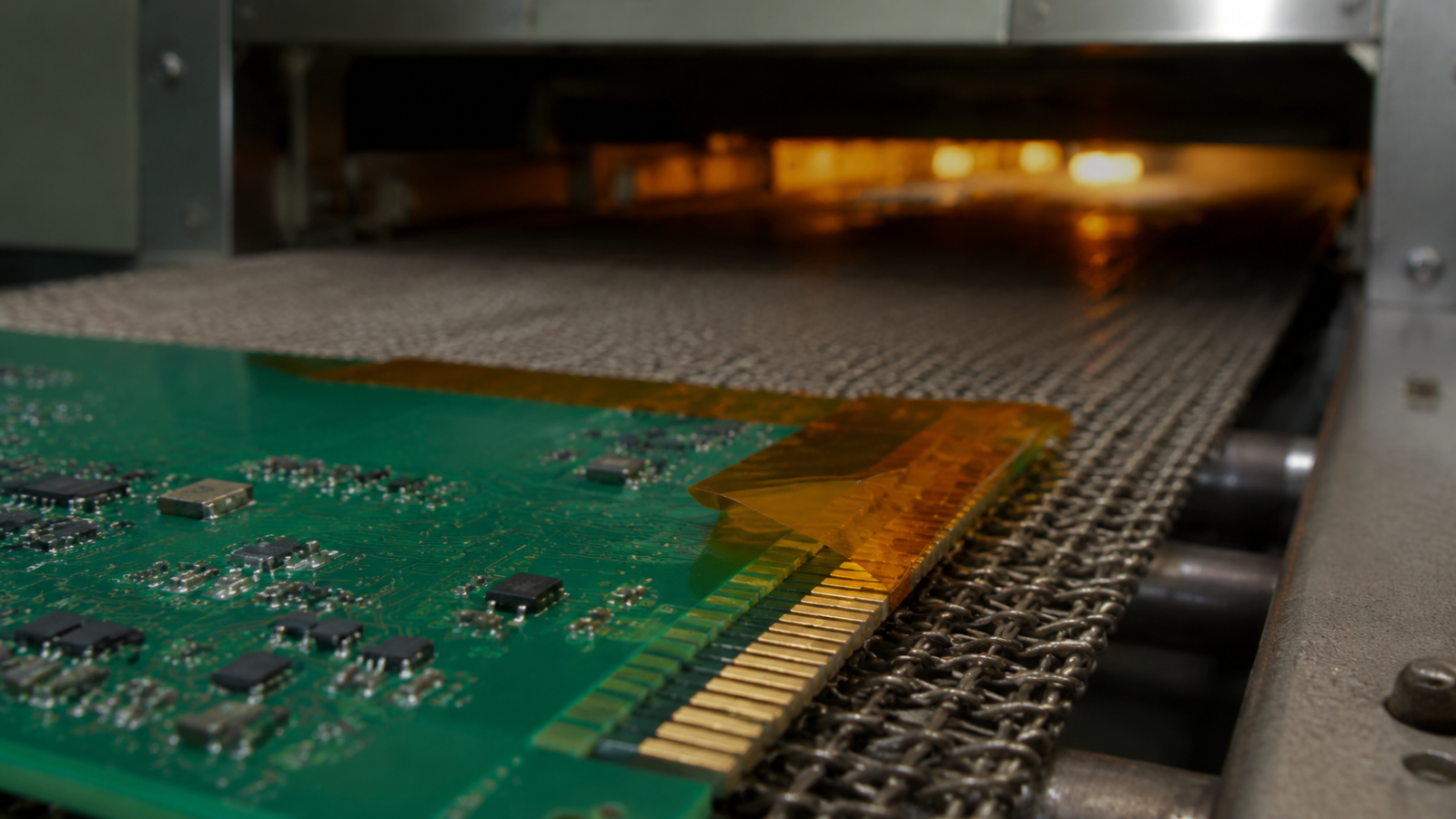
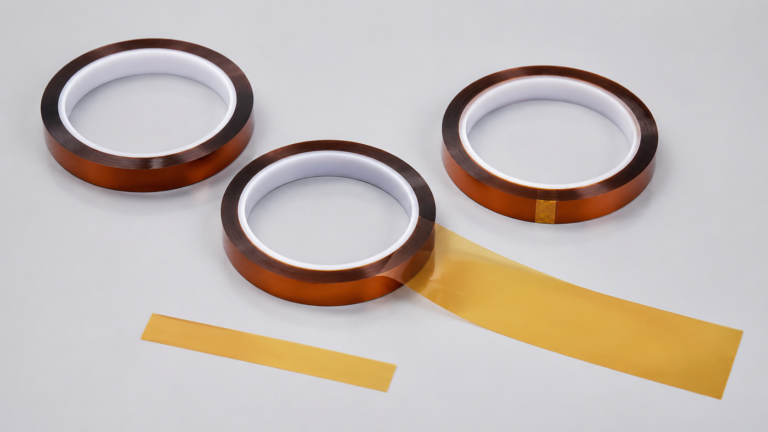
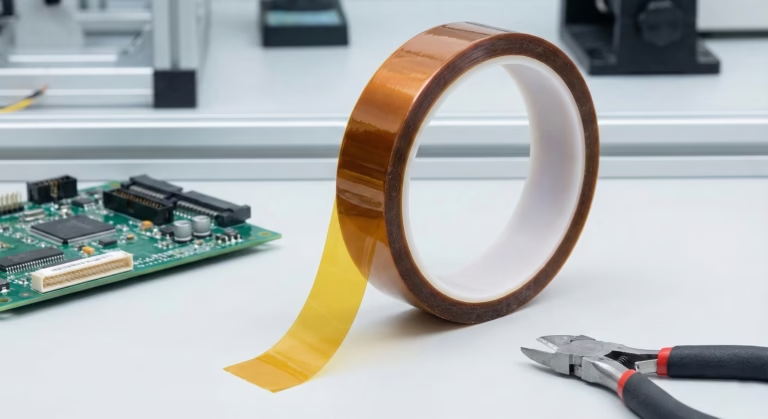
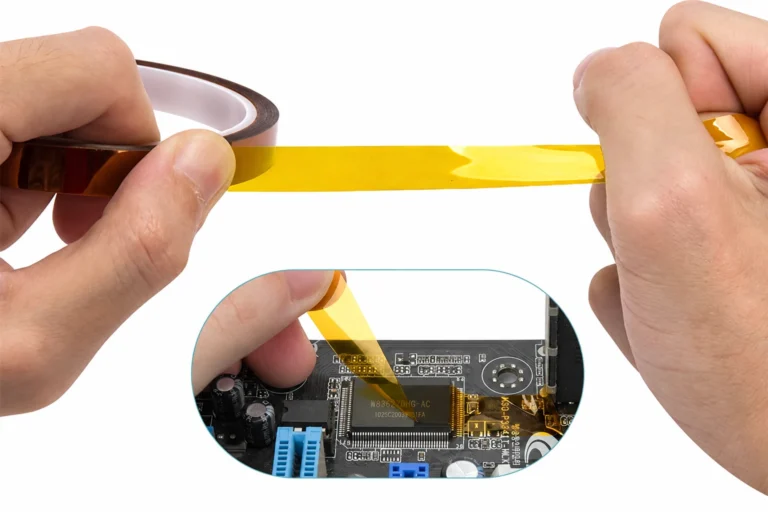
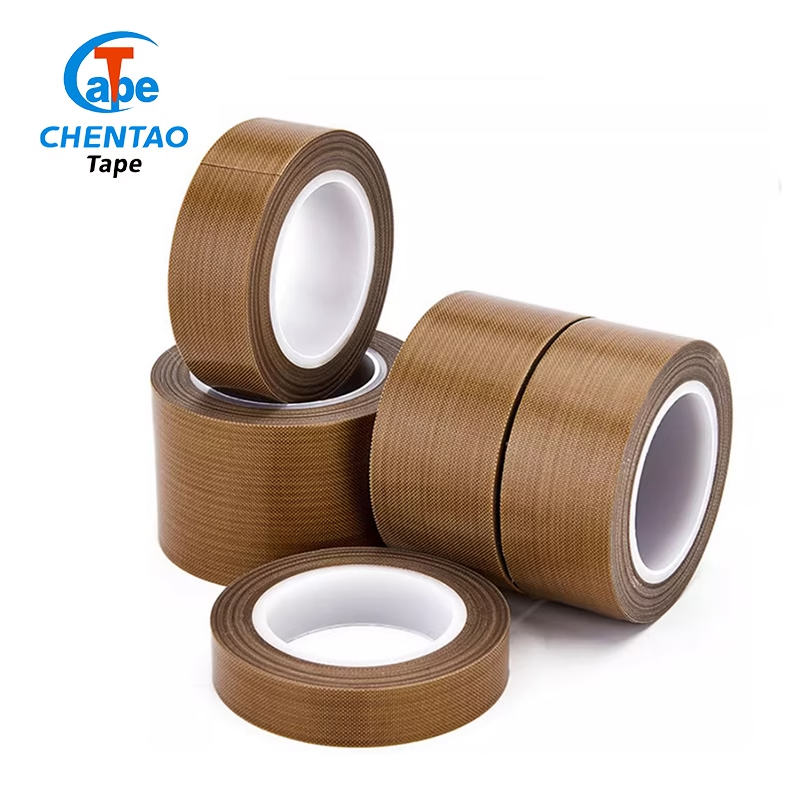
Polyimide (PI) tape is the amber-colored adhesive film engineered to outlast every other pressure-sensitive tape in extreme heat — rated for 260°C continuous service where PET tape shrinks, acrylic adhesives transfer, and standard masking tapes carbonize. This article examines five industrial applications where high-temperature polyimide tape is not a preference but a process requirement, with selection criteria, grade data, and qualification standards for each use case.
Looking for the complete polyimide tape reference? See the central hub: Polyimide Tape: Complete Engineering Guide (2026) — covering material science, adhesive systems, dielectric properties, grades, and all major application categories.
1. Why Standard Tapes Fail in High-Temperature Environments
1.1 The 150°C Barrier: Where PET and Acrylic Systems Break Down
Three materials dominate the industrial tape market below 150°C: PET film, acrylic PSA, and standard glass cloth. All three fail predictably above that threshold.
PET film has a glass transition temperature (Tg) of approximately 80°C and a continuous service ceiling near 150°C. Above that, dimensional shrinkage and adhesive bond loss occur progressively. Acrylic PSA begins flowing at 120°C; residue transfer onto PCB solder pads, motor windings, and aerospace connector pins creates contamination-driven field failures. Standard glass cloth tape handles temperature but absorbs moisture, adds dimensional thickness, and conforms poorly around tight bend radii.
Scroll sideways to compare all columns.
| Tape Type | Continuous Service Temp | Residue Risk | CTE (ppm/°C) |
|---|---|---|---|
| PET film | 150°C | Moderate above 120°C | 60 |
| Polyimide film | 260°C | Near-zero (silicone PSA) | 20 |
| PTFE film | 260°C+ | None | 100 |
| Glass cloth | 250°C | Low | — |
1.2 Polyimide Film: Thermal Stability from Imide Ring Chemistry
Aromatic polyimide’s imide ring linkage creates no thermal degradation pathway below approximately 350°C. Continuous service at 260°C (IEC 60216 / UL 746B) and short-term peak excursions to 400°C are achievable — the same profile IPC-4563 specifies for wave soldering. CTE of ~20 ppm/°C (versus PET’s 60 ppm/°C) minimizes dimensional drift across reflow cycles or motor thermal cycling.
DuPont pioneered the polyimide film category with Kapton® in the 1960s, establishing the thermal performance baseline that IEC and ASTM test standards are calibrated against. Independent PI tape manufacturers verify their products against those same standards, ensuring directly comparable performance data across sources.
1.3 Silicone vs Acrylic Adhesive at Elevated Temperature
Silicone PSA: full bond integrity through 260°C; near-zero residue on removal; compatible with VPI varnish systems in motor manufacturing. Use wherever adhesive residue would cause electrical, solderability, or adhesion defects on the mating surface.
Acrylic PSA: maximum 180°C continuous; acceptable for powder coating or industrial oven masking where post-removal surface cleanliness is less critical.
2. Application 1: SMT Reflow Masking for PCB Assemblies
2.1 Process Conditions
Lead-free reflow profiles (Sn-Ag-Cu / SAC305) reach peak temperatures of 245–260°C per IPC/JEDEC J-STD-020, with typical dwell of 30–60 seconds above 217°C liquidus. Tape must survive 3–5 reflow cycles without transferring adhesive to edge connectors, test points, plated through-holes, or selective gold contact areas.
2.2 Selection Criteria
- Film thickness: 25 μm (standard); less thermal mass gives a cleaner heat profile under the tape edge
- Adhesive: silicone PSA mandatory — acrylic residue on gold contact pads causes solderability failure per IPC-A-610 Class 3
- Peel force: 6–14 N/25mm (IPC-TM-650 2.4.9) — too low risks lift-off during convection airflow; too high risks substrate damage on removal
- Qualification protocol: IPC-4563 (3 × 260°C / 60 s dwell cycles, residue inspection, adhesion retention measurement)
2.3 Process Integration Notes
Apply to a cold, clean board; flux contamination beneath the tape edge creates a bleed path under reflow conditions. Remove within 30 minutes of cooling to minimize silicone PSA cross-linking. Die-cut formats are available for connector bodies, test point arrays, and fine-pitch IC packages.
For detailed surface preparation and removal techniques, see the How to Use Polyimide Tape for Masking.
3. Application 2: EV and Industrial Motor Winding Insulation
3.1 Temperature Class Requirements
EV motor stators operate continuously at 155–180°C (IEC 60085 Class F), with transient peaks exceeding 200°C during aggressive regenerative braking cycles. Class H insulation systems (180°C, UL 1446) require PI tape that qualifies as a recognized insulation material — a different specification than PCB masking grades.
Nitto Denko’s high-performance PI grades are frequently specified in Japanese EV platforms; suppliers entering these programs must demonstrate dielectric strength and thermal aging parity against established benchmarks through independent test data, not manufacturer datasheets alone.
3.2 Mechanical Demands Beyond Temperature
- Tensile strength: ≥170 N/25mm (ASTM D882) — required to survive coil winding tension under automated equipment without film tearing
- Elongation: ≥50% — conformability around motor slot entry radii eliminates air gaps that initiate partial discharge
- VPI compatibility: silicone PSA must not inhibit resin cure during vacuum pressure impregnation; confirm compatibility with the varnish supplier’s matrix before production commitment
3.3 Selection Criteria for Motor Applications
Film thickness: 50 μm for winding turn insulation; 25 μm for slot liner overlay only. Width: custom slitting to motor slot width (typically 10–60 mm, tolerance ≤±0.3 mm). Key test: breakdown voltage ≥4 kV AC (IEC 60243) after 1,000 h thermal aging at Class H temperature per IEC 60216.
4. Application 3: Aerospace Wire Harness and Cable Protection
4.1 Operating Conditions
Aircraft engine bay harnesses see continuous temperatures of 175–200°C with short-term excursions to 300°C+ near exhaust runners. Fuselage wiring requires flame and smoke compliance (UL 94 V-0, FAR 25.853). Traceability is mandatory: AS9100D and MIL-PRF-27 lot certification require a chain of custody from film supplier through slit conversion to final product lot.
4.2 Wire Harness Bundling Technique
Spiral overwrap per AS50881 (50% overlap) provides structural coverage while preventing chafe damage against airframe structures. A 25 μm PI tape overwrap is approximately 60% lighter than equivalent glass cloth braid for the same electrical isolation class — a measurable weight reduction across thousands of metres of harness in a commercial aircraft.
Full certification and documentation requirements are detailed in the Aerospace-Grade Polyimide Tape: Certifications and Traceability guide.
4.3 Qualification Documentation
Required per customer DVP: lot-traceable CoC plus test reports covering dielectric strength, flame, thickness, and adhesion retention. Shelf life declaration of 18–24 months from manufacture; cold storage (<10°C) is preferred for silicone PSA to prevent premature cross-linking. First article inspection must verify adhesion, residue behavior, and flame rating against the program-specific material specification before entering production.
5. Application 4: Powder Coating and Industrial Oven Masking
5.1 Process Conditions
Powder coating cure cycles run at 180–220°C for 15–25 minutes in an electrostatic spray environment that introduces additional particulate contamination risk at tape edges. Masking targets include threaded holes, bearing surfaces, mating flanges, and assembly datum features. Post-cure requirement: tape must remove cleanly without adhesive residue that would interfere with thread engagement or mating surface seating.
5.2 Adhesive Selection Trade-Off
Acrylic PSA (max 180°C continuous): cost-effective for cure cycles at or below 180°C; light residue may need a solvent wipe on cosmetically critical surfaces such as automotive exterior trim.
Silicone PSA: required for cure profiles ≥190°C or where surface cleanliness is critical (anodized faces, chrome-finished mating surfaces). Polyimide’s low CTE also prevents the edge-curling that PET masking tape exhibits at temperature, maintaining a tighter paint demarcation line.
5.3 Common Failure Modes and Mitigations
- Paint bleed-under: tape edge not fully seated — use 50 μm PI (stiffer edge, higher peel force) instead of 25 μm, and apply firm finger pressure along the full leading edge
- Adhesive residue after removal: cure profile exceeded tape rating — verify oven temperature profile with a calibrated thermocouple before committing to an adhesive grade
- Tape deformation over large gaps: 25 μm PI bridges poorly over clearance features — switch to 50 μm for better dimensional bridging across open geometry
6. Application 5: Transformer and Coil Interlayer Insulation
6.1 Role in Wound Component Construction
Layer-wound power transformers use PI tape to wrap each winding layer, providing turn-to-turn and layer-to-layer electrical isolation. PI tape is a recognized Class H insulation material (IEC 60085, IEC 60454-3-7). Compared to Nomex® paper at 100–300 μm thickness, 25–50 μm PI tape delivers a higher copper fill factor — more winding turns per unit core volume at the same insulation class, reducing total component size.
6.2 Dielectric Performance Requirements
- Volume resistivity: ≥10¹⁶ Ω·cm (ASTM D257), maintained through 20,000+ operating hours at rated class temperature
- Dielectric breakdown: ≥150 V/μm (IEC 60243) → ≥3.75 kV for 25 μm tape; adequate for most medium-voltage wound components
- Partial discharge resistance: PI film shows higher PD inception voltage than PET or cellulose paper (IEC 60270 comparative data); critical for inverter-fed motor drives with fast dV/dt switching where PD erosion drives insulation degradation
6.3 Application Technique
Wrap with 10–30% overlap to eliminate inter-layer gaps; maintain light winding tension to conform to bobbin corners and minimize air voids. Avoid folds and creases — mechanical stress concentrations from creasing reduce local dielectric withstand by up to 30%. After winding, verify insulation resistance with a 500 V DC megohmmeter before VPI resin impregnation to confirm absence of layer shorts.
7. Grade and Thickness Selection for Each Application
Scroll sideways to compare all columns.
| Application | Film Thickness | Adhesive Type | Typical Width Range | Key Test Standard |
|---|---|---|---|---|
| SMT reflow masking | 25 μm | Silicone PSA | 5–50 mm | IPC-4563, IPC-TM-650 |
| EV / motor winding (turn insulation) | 50 μm | Silicone PSA | 10–60 mm (custom) | IEC 60243, UL 1446 |
| Aerospace wire harness overwrap | 25 μm | Silicone PSA | 12–50 mm | MIL-PRF-27, AS50881 |
| Powder coating / oven masking | 50 μm | Acrylic or Silicone | 6–50 mm | — |
| Transformer / coil interlayer | 25–50 μm | Silicone PSA | Full bobbin width (custom) | IEC 60085, IEC 60243 |
For full dimensional data including peel force, elongation, and dielectric breakdown values by grade, see the Polyimide Tape Datasheet: Engineering Guide to Key Specs.
8. Selecting a Polyimide Tape Supplier
Four criteria consistently distinguish a qualified supply chain from a commodity purchase for thermal-critical applications.
Standards compliance documentation: every grade should carry an IEC 60454-3-7 material specification conformance, RoHS 2015/863/EU compliance, and REACH SVHC <0.1% w/w. For aerospace and motor insulation applications, IEC 60085 thermal class certification and UL 1446 recognition data are required at time of first order.
Lot traceability: a complete chain of custody — PI film supplier → slitting conversion → final product lot — documented in a CoC traceable by batch number. This chain is mandatory for aerospace DVP; it is best practice for all Class H insulation applications.
Application-specific sample evaluation: request test reports covering your specific substrate and process profile before volume commitment. A PCB reflow masking qualification differs from a motor winding slot liner qualification in both test protocol and acceptance criteria. Standard catalog widths (3 / 6 / 12 / 25 / 50 mm) should be available for sample dispatch within 5 business days; custom slit widths within 10–15 business days.
Technical response quality: an inquiry specifying film thickness, adhesive type, width, temperature ceiling, and applicable test standards should return a specific technical data sheet response, not a generic product brochure. The quality of the first technical reply is a reliable proxy for the supplier’s engineering depth.
To submit an inquiry or request application-specific samples, use the inquiry form.
9. Frequently Asked Questions
What is the maximum continuous service temperature for polyimide tape?
260°C continuous service (IEC 60216 / UL 746B); short-term peak excursions to 400°C are tolerated. Acrylic PSA grades are limited to 180°C continuous — verify the adhesive type before applying to high-peak-temperature processes where acrylic residue causes surface contamination.
How does polyimide tape compare to Kapton® tape?
Kapton® is DuPont’s registered trademark for its aromatic polyimide film. Generic polyimide tape is the product category; independent manufacturers produce PI tapes independently verified against the same IEC 60243 and ASTM D882 standards. Specifying “polyimide tape” with defined test pass values allows broader sourcing without sacrificing performance verification.
Is silicone or acrylic adhesive required for motor winding applications?
Silicone PSA is required for winding temperatures above 180°C or wherever VPI varnish compatibility matters. Silicone PSA maintains near-zero residue transfer through the full Class H temperature range. Acrylic PSA is not suitable for motor winding — residue at elevated temperatures contaminates varnish adhesion interfaces and reduces long-term insulation integrity.
Can polyimide tape be removed without leaving adhesive residue?
Silicone PSA grades leave near-zero residue on most substrates when removed within 24–48 h of cooling to room temperature. Removal after extended exposure (>72 h at 260°C) may require an isopropyl alcohol wipe. Acrylic PSA grades are not recommended for zero-residue applications above 120°C.
What overlap percentage is correct for aerospace wire harness overwrap?
AS50881 specifies 50% spiral overlap for structural harness overwrap. Industrial and commercial applications typically use 25–30% overlap, which maintains full surface coverage while reducing tape consumption per metre of harness length.
How do I request samples or custom slit widths?
Standard catalog widths are available for sample dispatch within 5 business days. Custom slit widths require 10–15 business days lead time. Submitting an inquiry with film thickness, adhesive type, width, temperature range, and applicable test standards results in a faster, more specific technical response.
Related Engineering Guides
- Polyimide Tape: Complete Engineering Guide (2026) — Central hub: material science, grades, adhesive systems, full application taxonomy
- Polyimide Tape Datasheet: Engineering Guide to Key Specs — Spec tables, test methods, and grade comparison data
- How to Use Polyimide Tape for Masking — Application methods, surface preparation, removal techniques
- Aerospace-Grade Polyimide Tape: Certifications and Traceability — MIL-spec, AS9100D, lot-traceable CoC requirements
Find the right tape for your application
Tell us what you need to bond, your operating conditions and the size or quantity you have in mind. Our team can help with material selection, samples and a quotation.
Discuss my application