The Engineer’s Guide to Double Sided Foam Tape for Car Badges & Emblems
Selecting the correct double sided foam tape for car badges is critical for preventing field failures. This guide covers acrylic vs. PE foam, surface preparation, and validation for automotive exteriors.
Selecting the correct double sided foam tape for car badges is critical for preventing field failures and expensive warranty claims. Automotive engineers and procurement teams must balance adhesive strength with the viscoelastic properties required to handle thermal expansion on vehicle exteriors. Choosing the wrong tape specification can lead to emblems lifting (winging) or falling off entirely after exposure to UV radiation, road salts, and car wash chemicals.
Quick Answer (TL;DR)
- Core Recommendation: Use acrylic foam tape (viscoelastic) for exterior applications. It absorbs dynamic stress better than rigid polyethylene (PE) foam.
- Thickness Factor: Match tape thickness to the badge’s recessed depth. Common specs are 0.4mm, 0.8mm, and 1.1mm to ensure full wet-out.
- Surface Prep: Cleaning with a 50:50 Isopropyl Alcohol (IPA) and water mix is non-negotiable. Adhesion promoters are required for LSE plastics like TPO.
- Cure Time: Bond strength builds over time. 50% strength is reached in 20 minutes; 100% requires 24-72 hours.
About This Guide
Scope: This guide applies to pressure-sensitive polyimide and acrylic foam tapes used for exterior automotive badging, emblems, and lightweight trim.
Verification: All performance claims must be cross-referenced with specific supplier technical datasheets (TDS). Verify temperature ratings, shear strength, and solvent resistance.
Last Updated: 2025-12-29
Reviewed by: Applications Engineering

Critical Selection Criteria for Emblem Tape
Foam Core Material: Acrylic vs. Polyethylene (PE)
The core material dictates the tape’s longevity in outdoor environments. Acrylic foam is viscoelastic, meaning it acts like a thick liquid that relaxes under stress. This is vital for exterior badges that expand and contract at different rates than the metal body panel during thermal cycling (e.g., -40°C to 90°C). Polyethylene (PE) foam is generally more rigid and prone to splitting under these shear forces, making it better suited for interior applications or temporary mounting.
Adhesive System: Pure Acrylic for Durability
Exterior tapes must resist environmental attacks. Pure acrylic adhesive systems resist UV degradation and common automotive chemicals, such as windshield washer fluid, gasoline vapors, and road salts. Rubber-based adhesives often degrade (yellow and brittle) under UV exposure and are not recommended for permanent exterior badging.
Micro Case Example: A chrome trunk emblem on a hatchback. The rear of the vehicle collects road spray and exhaust particulates. A pure acrylic adhesive prevents the bond from degrading despite constant exposure to these contaminants.
Gap Filling & Conformability
Car panels are rarely perfectly flat, and badge injection molds have tolerances. The tape must be conformable enough to maintain 100% surface contact. Rigid tapes may lift at the edges (winging) if the badge curvature does not perfectly match the body panel. Select a thickness that accommodates the mismatch, typically ranging from 0.4mm to 1.1mm depending on the specific part design (consult our product catalog for available thicknesses).
Temperature Resistance
Automotive specs typically require performance across broad temperature ranges. Verify the specific grade’s datasheet for “Static Shear” performance at elevated temperatures. Acrylic foam tapes generally maintain holding power up to 90°C or higher, whereas general-purpose foams may soften and slide.
Substrate Compatibility & Surface Energy

Scenario A: Bonding Chrome-Plated ABS to Clear Coat
Chrome-plated ABS badges and automotive clear coats (urethane, epoxy, or carbamate) are typically High Surface Energy (HSE) substrates. These bond well with standard automotive acrylic foam tapes. Ensure the clear coat is fully cured (outgassed) before application to prevent bubbling or paint damage.
Scenario B: Low Surface Energy (LSE) Plastics
Some trim pieces, such as side moldings or bumper protectors, use Polypropylene (PP) or Thermoplastic Olefins (TPO). These are Low Surface Energy (LSE) materials (often < 38 dynes/cm). Adhesives struggle to “wet out” on LSE surfaces. You must use a tape specifically formulated for LSE bonding or apply a liquid adhesion promoter (primer) to the plastic before applying the tape.
Micro Case Example: Unpainted TPO Bumper Trim. Standard acrylic tape will peel off TPO within days. Using a primer like 3M 94 or an LSE-specific modified acrylic adhesive ensures the tape fuses to the plastic surface.
Testing Surface Energy
To verify surface energy quickly:
- Water Bead Test: Spray water on the substrate. If it beads up into tight spheres, the surface energy is low (difficult to bond). If it flows out into a flat puddle, the surface energy is high (easy to bond).
- Dyne Pens: For precise measurement, use dyne pens to determine the exact surface energy level in dynes/cm.
Decision Aid: Selecting the Right Tape
Use this table to evaluate potential tape candidates against your project requirements.
| Selection Criteria | How to Verify | Failure Risk if Ignored |
|---|---|---|
| Foam Core Type | Check TDS for “Viscoelastic” or “Acrylic Foam” vs “PE Foam”. | Cohesive Failure: PE foam may split or detach under thermal expansion stress. |
| Adhesive Chemistry | Confirm “Pure Acrylic” or “Modified Acrylic” on datasheet. | UV Degradation: Rubber adhesives turn yellow and brittle in sunlight. |
| Tape Thickness | Measure badge recess depth vs. body panel curvature. | Winging/Lifting: Tape too thin won’t contact the center; too thick looks unsightly. |
| LSE Compatibility | Perform Dyne Pen test on badge plastic (e.g., TPO/PP). | Adhesive Pop-off: Tape won’t stick to the badge itself without primer. |
| Plasticizer Resistance | Ask supplier for “Plasticizer Resistance” rating if bonding flexible vinyl. | Bond Softening: Adhesive turns to goo as chemicals migrate from the badge. |
Die-Cut vs. Roll Form: Sourcing Considerations

Precision Die-Cutting
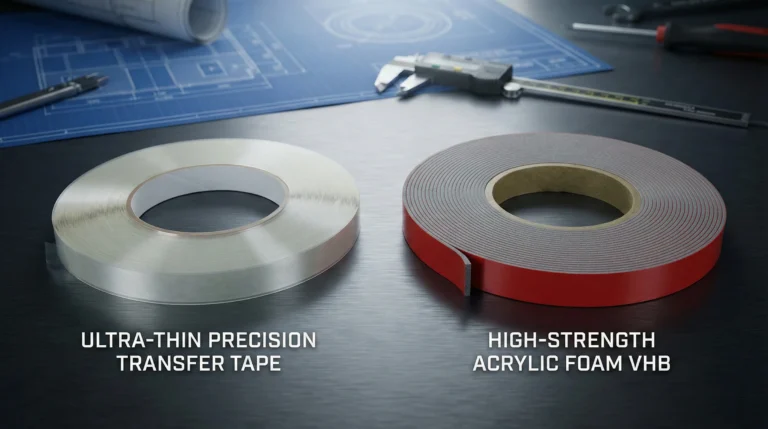
For OEM production, die-cut parts are standard. Converters use rotary or flatbed die-cutting to match the tape to the exact profile of the badge letters. This eliminates manual trimming and ensures a professional finish with no visible adhesive edges (“bleed”). If you require custom shapes, please contact our engineering team for tooling options.
Micro Case Example: Complex Script Logos. A “Turbo” script badge with separated letters requires a kiss-cut liner where the tape is pre-spaced. Manual application from a roll is impossible for these geometries.
Liner Tabs for Assembly Speed
Die-cut parts can be supplied with extended liner tabs (finger lifts). These tabs allow assembly line workers to remove the liner quickly while wearing protective gloves, significantly reducing cycle time per vehicle.
Roll Form
Rolls are preferred for long linear moldings or aftermarket repair shops where badge shapes vary. Technicians cut the length required manually. While flexible, this method is slower and less precise than using die-cut parts.
Application Process for Maximum Retention
Step 1: Surface Cleaning & Abrasion
Contaminants are the primary cause of failure. Clean both surfaces with a 50:50 mixture of Isopropyl Alcohol (IPA) and water. Safety Note: IPA is flammable. Ensure adequate ventilation and consult the SDS. Wipe in one direction (unidirectional wiping) to lift dirt rather than smearing it around.
Step 2: Application Pressure (Wet-out)
Pressure-sensitive adhesives (PSA) require physical force to activate. Apply firm pressure (typically 15 psi / 100 kPa) across the entire badge using a roller or hand pressure. This forces the adhesive into the microscopic texture of the paint and the badge, maximizing the bond area (“wet-out”).
Step 3: Dwell Time & Temperature
Do not apply tape below 10°C (50°F) unless using a specialized cold-weather grade. The adhesive is too stiff to wet out properly in the cold. After application, the bond strength increases over time:
- 20 Minutes: ~50% strength (handle with care).
- 24 Hours: ~90% strength.
- 72 Hours: 100% strength (ready for car wash).
Failure Modes & Troubleshooting

Mode 1: Adhesive Failure (Pop-off)
If the tape lifts cleanly off the car panel with no residue, it is an adhesive failure (interfacial failure). This almost always indicates poor surface cleaning (wax, grease, or dust remained) or application at temperatures that were too cold for the adhesive to flow.
Mode 2: Cohesive Failure (Foam Split)
If the foam tears down the middle, leaving residue on both the badge and the car, the bond was successful. The failure occurred because the mechanical stress exceeded the foam’s internal strength. This suggests the tape area was too small for the load (undersized tape) or the foam grade was insufficient for the impact.
Mode 3: Plasticizer Migration
If the adhesive turns to goo and loses tack, plasticizers may have migrated from a soft plastic badge (like flexible PVC) into the adhesive. Use an adhesive system designed specifically to resist plasticizers.
Implementation & Validation Checklist
- Pre-Sourcing: Identify the exact material of the badge (LSE vs HSE) and the vehicle clear coat system.
- RFQ Stage: Request peel adhesion data relevant to automotive clear coats. Generic steel adhesion data may not reflect performance on modern scratch-resistant paints.
- Incoming QC: Check that the tape thickness matches the specification. Verify that the release liner removes easily without tearing.
- Process Control: Monitor application temperature and pressure. Ensure SOPs are followed strictly regarding dwell time.
Questions to Ask a Supplier
Before finalizing your adhesive choice, ask your supplier these critical questions to ensure the product meets automotive standards:
- Do you have peel adhesion data specifically for automotive clear coats?
- Is the foam core 100% acrylic or a polyethylene blend?
- What is the minimum application temperature for this specific grade?
- Does this tape require an adhesion promoter for TPO or Polypropylene surfaces?
- Can you provide die-cut samples for prototyping and fit-checks?
- What is the shelf life of the unapplied tape, and what are the storage conditions?
- Do you offer extended liner tabs (finger lifts) to improve assembly line speed?
- Is the adhesive system resistant to plasticizer migration from vinyl badges?
- What is the recommended dwell time before the vehicle can be exposed to rain or car washes?
- Can you supply a Certificate of Analysis (CoA) with every production batch?
External References
Frequently Asked Questions
What is the best thickness for car emblem tape?
Common thicknesses range from 0.4mm to 1.1mm. Thicker tapes (0.8mm+) are better for filling gaps on curved surfaces or badges with recessed backs. Always check the badge design to determine the required gap fill.
Can I use standard double sided tape for exterior badges?
No. Standard general-purpose tapes lack the UV resistance and viscoelasticity required for automotive exteriors. They will likely fail after exposure to rain, sun, and vibration.
How do I remove old foam tape without damaging the paint?
Use a heat gun on a low setting to soften the adhesive, then use a fishing line to slice through the foam. Remove remaining residue with an automotive-safe adhesive remover or a rubber eraser wheel. Always test solvents on an inconspicuous area first.
Does temperature affect the initial bond strength?
Yes. Cold temperatures harden the adhesive, preventing it from flowing into the surface. Apply tape between 18°C and 30°C for optimal initial wet-out. Once cured, the tape can withstand much wider temperature ranges.
Need a tape solution for your project?
Share your application, drawings and target price. Our engineering team will recommend suitable tape structures and send you a quote within 24 hours.
Get a Custom Tape Recommendation