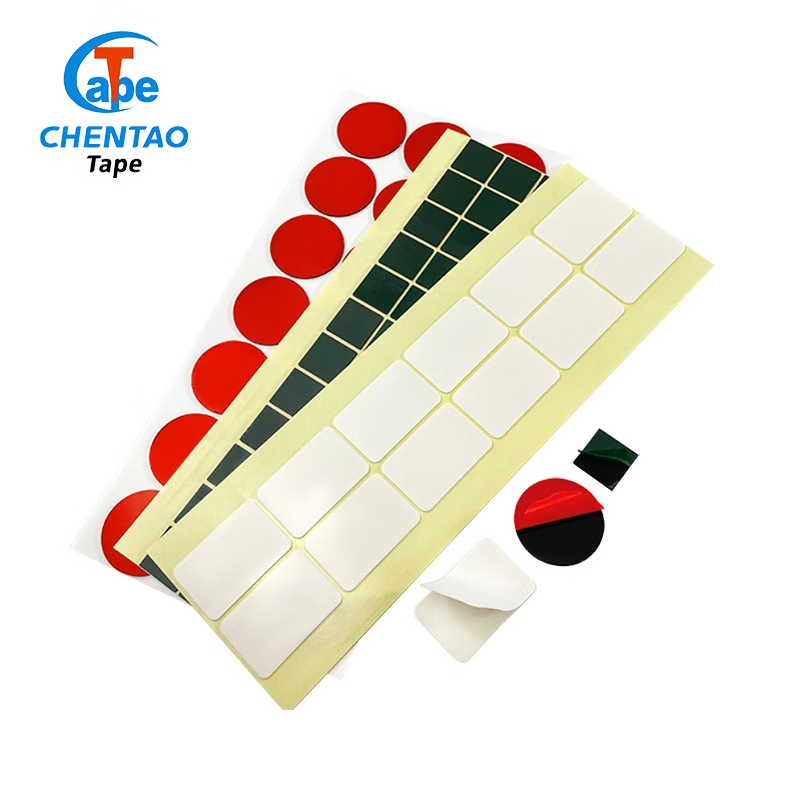
High Temperature Double Sided Tape: Essential Guide 2026
- Selection: match adhesive and carrier to the continuous service conditions.
- Failure checks: review edge lift, ooze, shear creep and thermal cycling.
- Before production: test on actual surfaces under the expected load.
On this page
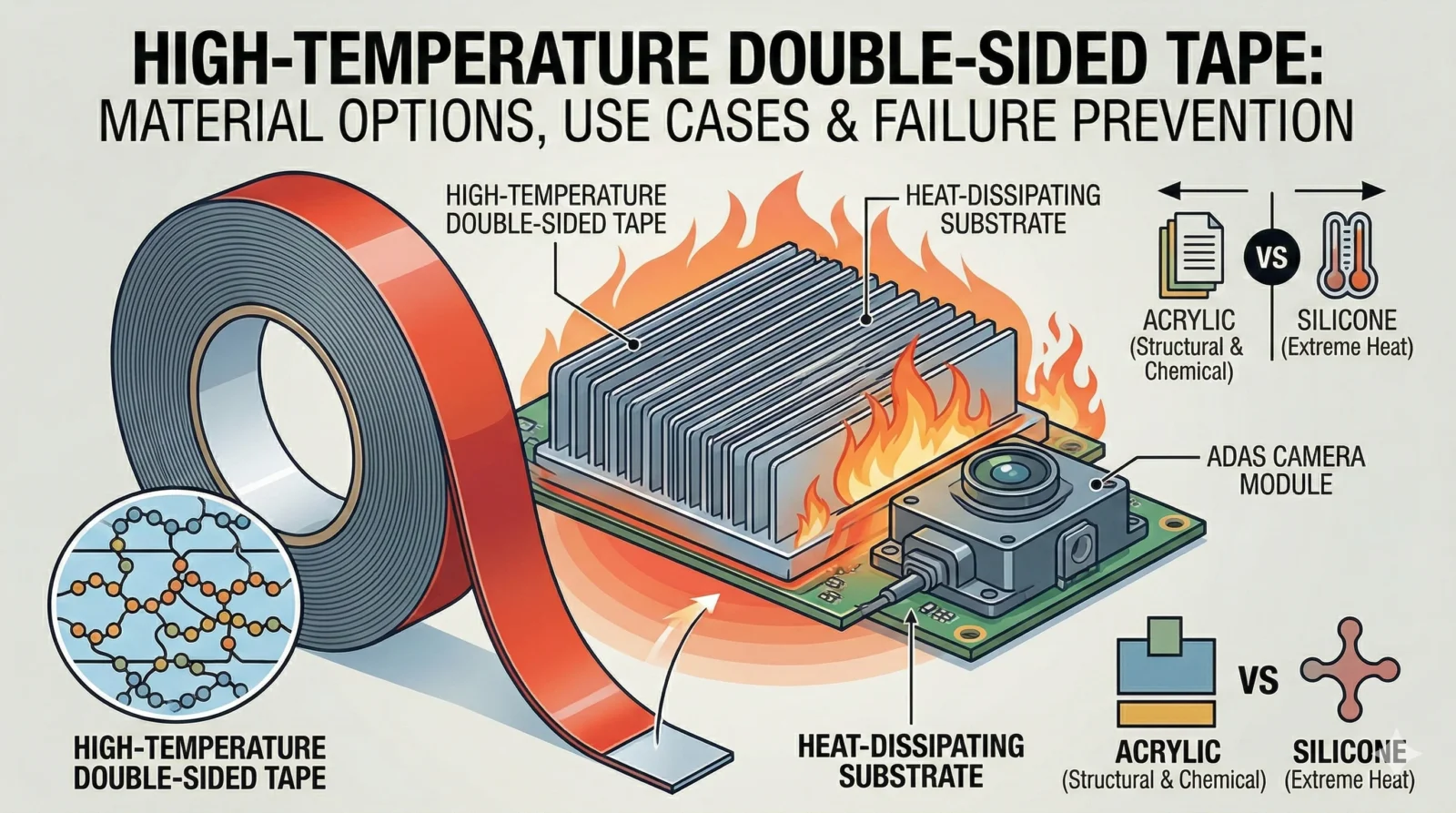
High temperature double sided tape is a pressure-sensitive adhesive system — carrier or foam core plus a cross-linked acrylic or silicone PSA — engineered to hold bond integrity above 150°C where standard rubber-based tapes ooze, creep, or delaminate. This guide covers the four thermal failure modes engineers must design against, the performance ceiling of acrylic versus silicone adhesive chemistries, and a surface-preparation checklist that governs most bond failures in electronics, automotive, and industrial applications.
Central reference: For a full comparison of double-sided tape types — acrylic foam, nano tape, rubber-based — see the Double-Sided Tape Engineering Comparison Guide.
1. What Is High Temperature Double Sided Tape?
1.1 Defining “High Temperature” — Thermal Threshold Classification
Standard rubber-based PSA tapes soften at 60°C–80°C, making them unsuitable for under-hood or reflow environments. The industry threshold for “high temperature” classification is continuous service at ≥ 150°C, with short-term excursion tolerance ≥ 200°C. Two practical sub-tiers define the market:
- Tier 1 (150°C–200°C): Modified acrylic PSA covers most electronics assembly, LED module mounting, and EV battery pack exterior bonding where thermal demand is moderate and cost control matters.
- Tier 2 (200°C–260°C+): Silicone PSA is required for SMT reflow, motor winding insulation, aerospace wire harness, and under-hood powertrain — environments where acrylic chemistry cannot maintain shear resistance.
The double-sided format bonds two dissimilar substrates — metal-to-plastic, glass-to-PCB — without visible hardware, which is critical in slim consumer electronics and aesthetic automotive trim. For comparison with high-temperature single-sided performance in solvent-based PET applications, see the high-temperature solvent-based PET tape guide.
1.2 Core Construction: Carrier, Foam Core, and Adhesive Layers
Construction variant determines gap-fill capacity, bond-line thickness, and vibration damping:
- Foam core (acrylic foam or PE foam): 0.25–2.0 mm thick; absorbs vibration and differential thermal expansion between substrates; the preferred choice for automotive body panel and sensor housing bonding.
- Film carrier (PET or PI film): near-zero thickness contribution; high shear rigidity; used where precise bond-line thickness is critical, as in PCB component mounting and display bonding.
- Transfer tape (adhesive-only, no carrier): ultra-thin bond line; used in optical bonding and fine-pitch electronic assembly.
Adhesive coat per side typically runs 25–100 μm; a heavier coat raises peel strength but increases ooze risk at elevated temperature. Release liners are silicone-coated paper for standard application or PE film when die-cut automation compatibility is required.
2. How Heat Degrades Adhesive Bond Integrity
2.1 The Four Thermal Failure Modes
Understanding failure mechanisms enables correct specification before qualification testing begins.
Edge lift occurs when differential CTE between bonded substrates — aluminum at ~23 ppm/°C versus polycarbonate at ~65 ppm/°C — creates peel stress at bond edges. Adhesive softened by heat cannot resist the resulting tensile force, and corners peel outward progressively over thermal cycles.
Adhesive ooze follows when heat reduces PSA viscosity below its working range. The adhesive migrates laterally under compression or gravity, contaminating lenses, connectors, or contact pads adjacent to the bond zone and creating both functional and cosmetic defects.
Shear creep is slow progressive sliding of one substrate relative to the other under static load. Rubber and standard acrylic PSA are particularly susceptible above 80°C. Cross-linked acrylic and silicone chemistries resist creep up to their rated temperature ceiling.
Thermal cycling de-bonding results from repeated expansion-contraction cycles — for example, −40°C to +150°C on EV battery packs or exterior ADAS modules — that micro-fracture the adhesive interface over hundreds of cycles. Foam-core tapes absorb more cumulative strain than film-carrier tapes and are preferred for high-cycle-count environments.
2.2 Continuous Service Temperature vs Short-Term Peak Ratings
The most common misapplication is specifying a tape by its short-term peak rating for a continuous operating environment. Continuous service rating defines the temperature a tape can maintain bond integrity for ≥ 10,000 hours — the typical automotive Tier 1 durability standard. Short-term peak rating covers temperature withstood for minutes to hours, such as SMT reflow at 260°C for 30–60 seconds.
A tape rated 260°C peak but only 150°C continuous will creep and delaminate in a motor controller running at 180°C ambient. Engineering rule: always specify by continuous service temperature plus worst-case dwell time, and treat peak rating as a separate specification column requiring its own data sheet value.
3. Acrylic vs Silicone Adhesive: Engineering Comparison
3.1 Modified Acrylic PSA: Performance Ceiling and Chemical Resistance
Cross-linked polymer chains maintain viscoelastic properties up to 150°C–200°C continuous, with short-term capability to 220°C. High initial tack wets out quickly on metals, glass, and high-surface-energy plastics such as ABS and PC. Chemical resistance is excellent against petroleum-based oils, fuels, IPA, and ketones, making this chemistry well-suited for under-hood and industrial cleaning environments. On low-surface-energy (LSE) substrates — TPO, polypropylene, powder-coated surfaces — an adhesion primer is required before tape application.
3M™ 9472LE and tesa’s 4965 series are widely benchmarked modified acrylic high-temp tapes in automotive Tier 1 qualification, establishing the 150°C continuous / 200°C short-term performance envelope that cross-industry specifications calibrate against. Modified acrylic is the cost-effective first choice when continuous operating temperature stays below 180°C.
3.2 Silicone Adhesive: Extreme-Temperature Range and Limitations
Silicone polymer backbone is thermally stable to 260°C continuous; specialty grades tolerate short-term peaks to 320°C–350°C. The primary production-floor challenge is low initial tack: silicone PSA requires longer dwell time (24–72h) and higher application pressure (≥ 15 PSI) to achieve rated peel strength — a parameter that must be communicated clearly to assembly line operators to prevent premature handling failures.
LSE bonding is a unique silicone advantage: direct adhesion to silicone rubber, PTFE, and powder-coated surfaces without primer, a capability acrylic cannot match. One chemical resistance limitation to note: silicone adhesives swell in certain hydrocarbon solvents and should not be used in prolonged immersion in toluene, xylene, or chlorinated solvents.
3.3 Adhesive Selection Decision Matrix
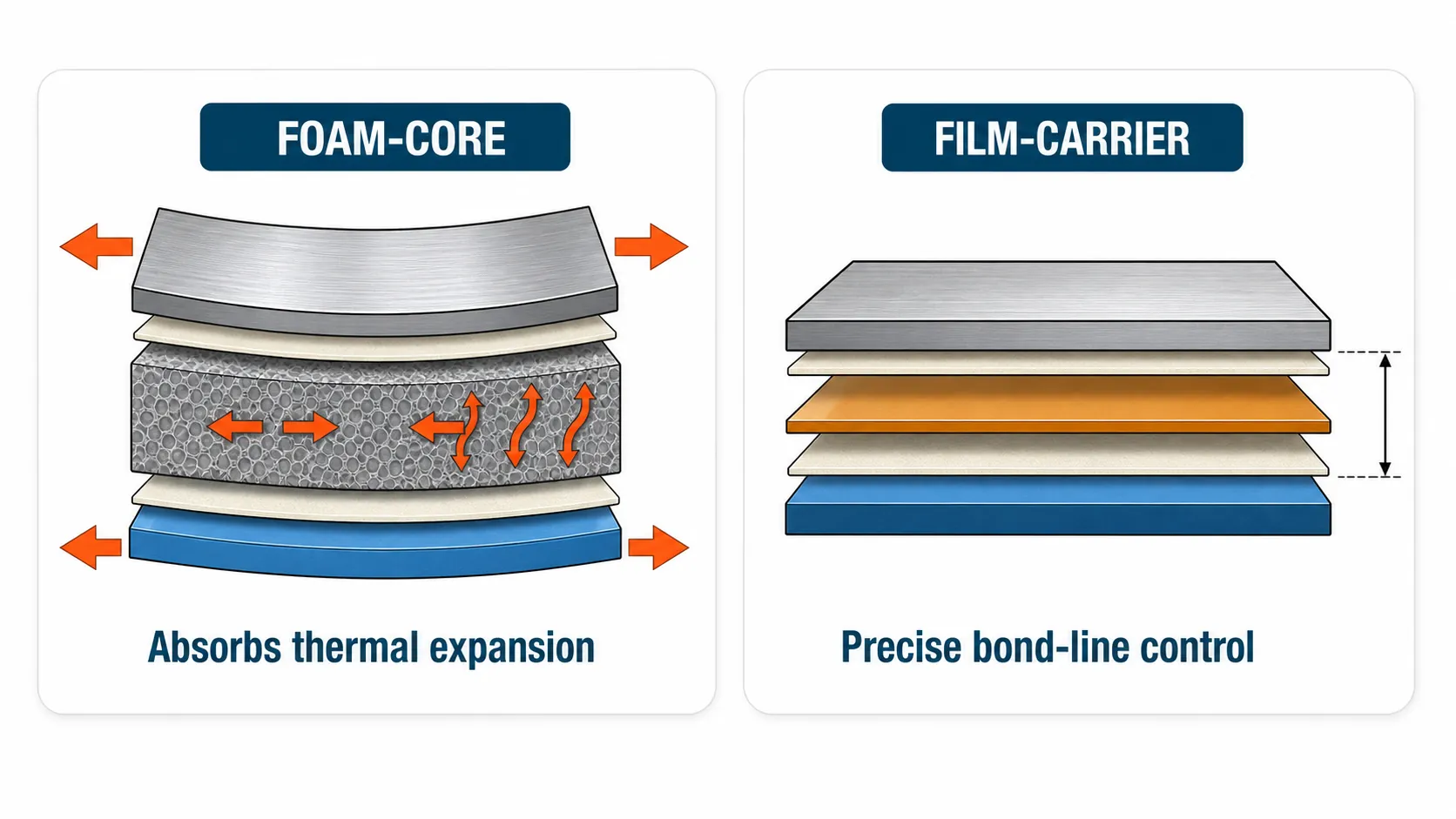
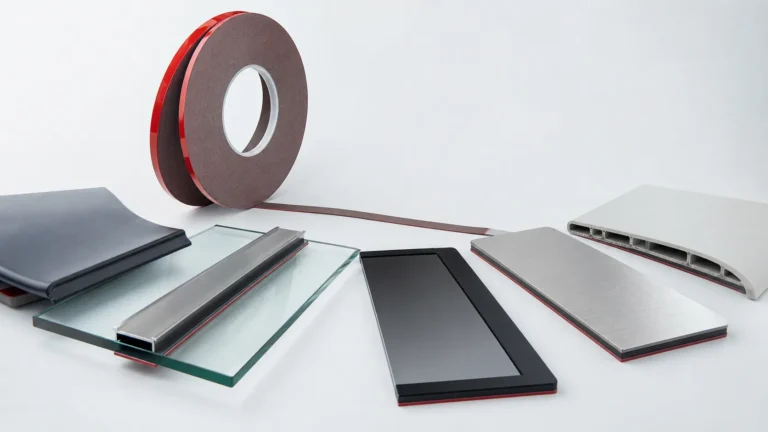
Foam-core (left) vs film-carrier (right) high temperature double sided tape: foam absorbs differential thermal expansion; film-carrier provides precise bond-line thickness control.
Scroll sideways to compare all columns.
| Parameter | Modified Acrylic | Silicone PSA |
|---|---|---|
| Continuous service temp | 150°C–200°C | 200°C–260°C+ |
| Short-term peak | 220°C | 320°C+ |
| Initial tack | High (immediate grab) | Low (requires dwell) |
| Chemical resistance | Excellent (oils, IPA, fuels) | Moderate (avoid hydrocarbons) |
| LSE plastic bonding | Primer required | Direct bond |
| Dielectric strength | Moderate | High (silicone film) |
| Cost index | 1.0× | 2.5–4× |
| Best fit | Electronics <180°C, automotive exterior | SMT reflow, motor winding, under-hood >180°C |
Do not over-specify silicone when acrylic meets the thermal envelope — the higher cost and lower initial tack create production-floor inefficiency without performance benefit.
4. Application Environments and Thermal Demand Profiles
4.1 Electronics Assembly: PCB, LED Modules, and EV Battery Packs
PCB component mounting and stiffener bonding typically uses film-carrier acrylic tape with a 25–50 μm bond line. Temperature demand sits at 85°C–125°C; the primary concern is dielectric isolation and zero outgassing near ignition sources (UL94 V-0 is required). LED module heat spreader bonding requires foam-core acrylic tape at 0.5–1.0 mm with thermal conductivity ≥ 0.5 W/m·K to transfer heat to the mounting substrate; temperature demand at junction reaches 150°C–180°C.
EV battery pack exterior bonding — module-to-tray or BMS bracket mounting — calls for foam-core acrylic tape at 1.0–2.0 mm. Temperature demand is 80°C–120°C continuous with −40°C cold-cycle shock, and the foam core’s vibration-damping property reduces fatigue on adjacent weld points. For optical sensors, LIDAR modules, or enclosed camera housings, specify low-outgassing grade (≤ 0.1% TML per ASTM E595); standard foam-core tapes may not qualify.
4.2 Automotive Exterior and Under-Hood Mounting
ADAS sensor housings — camera, radar, LIDAR — need foam-core acrylic tape certified to ASTM B117 salt spray and ISO 9227 for exterior locations, with a thermal range of −40°C to +120°C and UV resistance. Decorative trim and body panel bonding uses acrylic foam core at 1.0–3.0 mm to absorb thermal expansion differential between painted metal and plastic trim (≥ 50 ppm/°C CTE mismatch), replacing mechanical clips in vehicle weight-reduction programs.
Under-hood powertrain sensor and bracket mounting demands silicone tape with 180°C–220°C continuous rating. Engine bay vibration plus thermal cycling requires high shear resistance; confirm compatibility with engine-bay fluids — coolant, brake fluid, motor oil — before finalizing specification. A common misspecification is using exterior-grade acrylic foam tape in under-hood positions, which fails at 150°C+ because the acrylic ceiling falls below exhaust-adjacent temperatures.
4.3 Industrial Equipment and Structural Bonding
Industrial oven gasket and panel mounting requires silicone tape rated to 260°C; food-processing applications also require FDA compatibility verification of all adhesive layers. Heat-sink and thermal interface component bonding uses a thermally-conductive variant (≥ 1.0 W/m·K) to replace mechanical clamps in tight-tolerance packages. Nameplate and signage bonding in high-temp environments uses modified acrylic on stainless or anodized aluminum; specify peel ≥ 40 N/25mm at test temperature per ASTM D903 or PSTC-101.
Key Takeaway: Match the adhesive tier to the actual continuous operating temperature, not the short-term peak — most real-world failures occur because an acrylic tape is used in an environment that exceeds 180°C, where only silicone can sustain shear resistance.
5. Surface Preparation and Bond Reliability Parameters
5.1 Substrate Cleaning and Primer Selection
Surface preparation governs the majority of real-world bond failures. Standard clean: 50/50 IPA-water wipe to remove mold-release agent, cutting oil, dust, and fingerprint contamination; wipe in one direction only — do not re-wipe, which reintroduces contamination. Surface energy threshold for adequate adhesion without primer is ≥ 36 mN/m; test with a water-break-free check or Dyne pen before taping.
LSE plastics (TPO, polypropylene, polyethylene) require an adhesion promoter appropriate to the substrate before taping; allow primer to flash off per the TDS before applying tape. Silicone substrates need light abrasion plus a compatible primer — some primers designed for acrylic adhesives will repel silicone PSA and produce a bond failure at the primer-to-tape interface rather than at the substrate.
5.2 Application Pressure, Dwell Time, and Cure Conditions
Minimum application pressure is 15 PSI (≈ 100 kPa) using a firm rubber roller or pneumatic laminator. Insufficient pressure leaves incomplete wet-out and weak initial peel strength regardless of adhesive chemistry. Dwell time at room temperature follows a predictable curve: 50% rated strength at 20 minutes, 90% at 24 hours, 100% at 72 hours per PSTC-1 method. Do not apply field stress before the 24-hour milestone for non-critical assemblies, or the 72-hour milestone for structural bonds.
Accelerated cure at 65°C for 1 hour achieves 90%+ strength for production-time-sensitive processes. For foam-core tapes, the tape compresses to 75% of nominal thickness under 15 PSI — design bond-line clearance based on compressed, not nominal, thickness. For silicone tape on LSE substrates, a post-bond heat soak at 80°C for 30 minutes accelerates PSA wetting and improves peel retention on subsequent thermal cycling tests.
5.3 Edge Sealing for Chemical Environments
Exposed foam-core tape edges in under-hood or wash-down environments are vulnerable to solvent ingress, which degrades the foam core faster than the adhesive faces. Apply a ≥ 3 mm bead of edge sealant — neutral-cure silicone or polyurethane — covering the full bond-line perimeter and inspect for gaps before final assembly. Verify that the sealant is chemically compatible with the adhesive system: some polyurethane sealants accelerate acrylic PSA degradation in elevated-temperature environments, which undermines bond integrity on joints that passed initial inspection.
6. Compliance Standards and Testing Parameters
Specifying the correct standards documentation upfront avoids re-qualification delays at OEM audit. Key standards by category:
- Flame rating: UL94 V-0 is the minimum for electronics OEM qualification. Confirm whether the base film, foam core, and adhesive are each independently rated — not just the combined laminate construction.
- Shear strength: ASTM D1002 (tensile-shear) measured at both 23°C baseline and rated service temperature; target ≥ 100 N/25mm at continuous operating temperature for structural bonding applications. Properties can drop 30–60% at 150°C compared to ambient baseline.
- Peel strength: ASTM D903 / PSTC-101 at 180° or 90°; specify peel on the actual target substrate (aluminum, painted steel, or PC) — values vary significantly by surface energy.
- Chemical resistance: ASTM D3359 adhesion after immersion in target fluids (fuel, coolant, brake fluid, IPA).
- Salt spray / corrosion: ASTM B117 (500h) or ISO 9227 for automotive exterior applications.
- RoHS / REACH: Required for EU export; request SVHC declaration and REACH SVHC screening report from supplier.
- Outgassing: ASTM E595; ≤ 0.1% TML, ≤ 0.01% CVCM for closed-optics environments such as LIDAR and camera modules.
Always require elevated-temperature test data at your specific operating temperature, not just the 23°C ambient baseline. For a complementary PSA peel-force and substrate-compatibility reference across tape families, see the nano tape complete guide.
7. Supplier Evaluation and Procurement Considerations
Four objective criteria determine whether a supplier can meet qualification requirements for thermal bonding applications:
- continuous-temperature rating supported by independent test data measured at operating temperature, not ambient baseline;
- product traceability and lot-level documentation for automotive Tier 1 or regulated industrial applications;
- conversion capability — slit widths, die-cut shapes, sequenced liner — for compatibility with automated assembly lines;
- lead time and minimum order flexibility to support development-phase samples without committing to production volume.
When requesting samples, specify the exact substrate pair, operating temperature, and target peel and shear values. Ask for test data measured on your actual substrate pair, not generic steel or glass reference data — adhesion values on painted TPO can differ by 40–60% from steel reference data, making generic data sheets unreliable for qualification.
ChenTao supplies high temperature double sided tape in both acrylic foam (CT-HT-AF series, 150°C–200°C continuous) and silicone adhesive (CT-HT-SI series, 200°C–260°C+) grades, with custom slit widths from 3 mm and die-cut shapes for automated assembly compatibility. Available documentation includes TDS, SDS, RoHS declaration, UL94 V-0 test report, and REACH SVHC screening. Contact us for a sample request or lead-time confirmation.
8. Frequently Asked Questions
What temperature can high temperature double sided tape withstand?
Continuous service temperature depends on adhesive chemistry: modified acrylic PSA maintains bond integrity at 150°C–200°C continuous, with short-term excursions to 220°C; silicone PSA handles 200°C–260°C continuous, with specialty grades tolerating short-term peaks to 320°C. Never specify a tape by its short-term peak rating for a continuous operating environment — the continuous service rating is the number that governs real-world bond durability in automotive, industrial, and electronics applications.
How do I stop high temperature double sided tape from melting or oozing?
Ooze occurs when the tape’s thermal ceiling falls below the operating temperature. If an acrylic tape is failing above 150°C, upgrade to cross-linked acrylic (ceiling 200°C) or silicone (ceiling 260°C+). Simultaneously verify surface prep: incomplete IPA clean or insufficient application pressure (< 15 PSI) reduces initial bond strength, making ooze-driven delamination appear earlier in service than expected on an otherwise correctly specified tape.
Does warming double sided tape during application improve bonding?
Mild heat at 40°C–65°C during application lowers PSA viscosity, improving contact area and initial wet-out — particularly beneficial for silicone adhesives with low ambient-temperature tack. This technique is distinct from exceeding the service temperature ceiling; 65°C application heat is well within any high-temp tape’s operating range. A post-bond heat soak at 65°C–80°C for 30–60 minutes also accelerates strength build on LSE substrates and is common practice in motor winding assembly.
Acrylic or silicone double sided tape for automotive under-hood use?
Silicone is the correct choice for under-hood positions with continuous temperature above 150°C — powertrain sensor brackets, engine compartment cable management, and exhaust-adjacent mounting all fall into this category. Modified acrylic foam tape is the right choice for exterior body and ADAS sensor positions below 120°C continuous, where vibration damping from the foam core is the primary performance requirement rather than extreme thermal resistance. The 2.5–4× cost premium for silicone makes chemistry matching critical to program economics.
What is the minimum order for custom-width or die-cut high temperature tape?
Sample rolls — typically 5–10 m — are available with no minimum order for development evaluation. Custom slit widths and die-cut shapes are available from standard production minimum orders, with die tooling charges waived above production volume thresholds. Contact us with your substrate pair, operating temperature, and target geometry for a sample request and lead-time confirmation.
Can high temperature double sided tape replace mechanical fasteners?
Yes, for loads within the PSA shear rating at operating temperature. Design rule: verify shear strength at operating temperature (not ambient baseline) and apply a safety factor of 3–5× for static loads or 5–10× for dynamic or vibration loads. For prolonged static loads at temperature, request creep resistance data from the supplier — PSA systems that pass ambient shear tests can still exhibit slow creep over thousands of hours at 150°C+. In chemical environments, add edge sealant as described in §5.3 to protect the bond-line perimeter from solvent ingress.
Find the right tape for your application
Tell us what you need to bond, your operating conditions and the size or quantity you have in mind. Our team can help with material selection, samples and a quotation.
Discuss my application