Double Sided Tape vs Acrylic Foam Tape: Engineering Selection Guide
Stop choosing by thickness alone. When comparing Double Sided Tape vs VHB, structure is everything. Thin tapes bond surfaces, but VHB manages the joint. Master the science of shear vs. peel loads and ensure your assembly survives thermal cycling and vibration with this engineering selection guide.
On this page
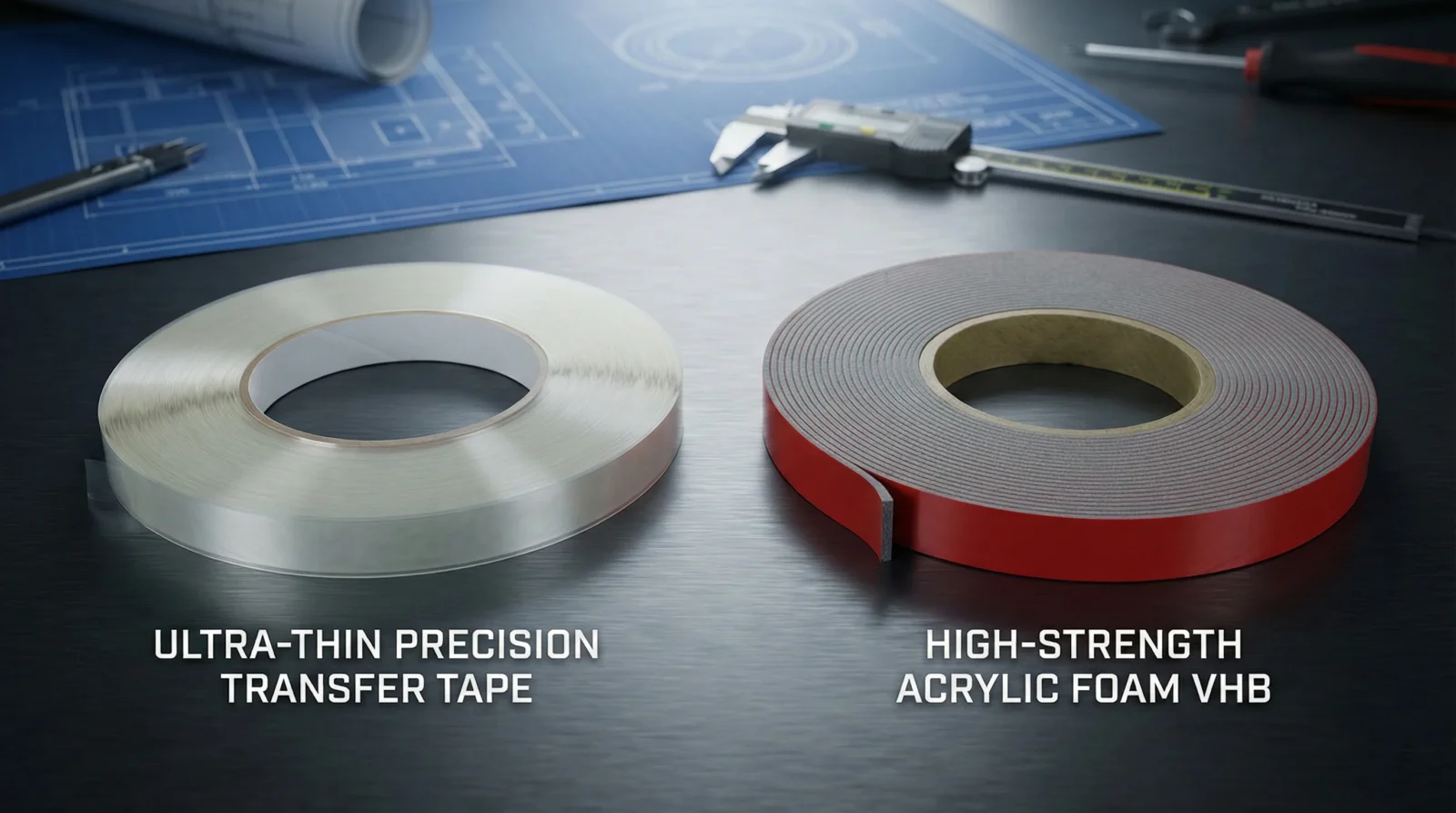
Most tape selection debates around acrylic foam tape vs double sided tape selection miss the point. The question is not which one is stronger. The question is whether your joint needs a thin, precise bonding layer — or a thicker, stress-absorbing structure that can handle movement, gaps, and thermal cycling.
Thin double sided tapes bond surfaces. Acrylic foam tapes manage the joint.
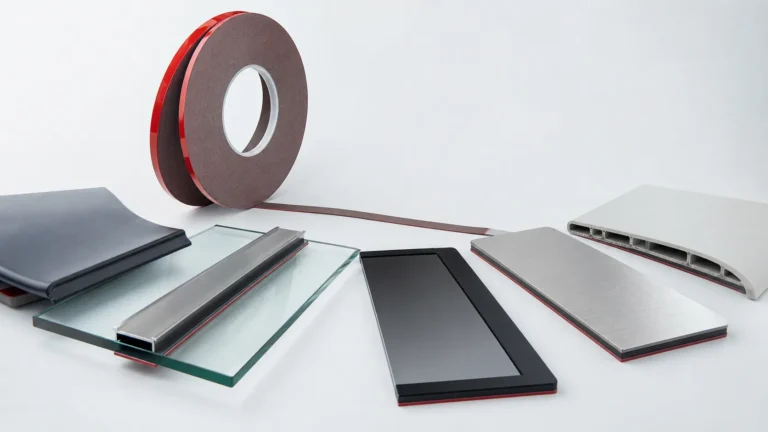
If you are specifying tape for mounting, trim attachment, or panel assembly and the search brings you to comparisons involving 3M™ VHB™ Tape, you are really comparing two fundamentally different tape architectures. The brand name describes one category of acrylic foam tape. The engineering decision sits one level deeper: foam core versus thin carrier — and which one matches your load mode, substrate conditions, and service environment.
At a Glance — Quick Comparison Table
Scroll sideways to compare all columns.
| Selection Factor | Thin Double Sided Tape | Acrylic Foam Tape |
|---|---|---|
| Bondline thickness | 0.05–0.25 mm typical; tight tolerance | 0.25–3.0 mm; gap-filling capability |
| Gap filling & surface texture | Limited — requires well-mated, flat surfaces | Strong — viscoelastic foam core conforms to minor steps, waviness, textured coatings |
| Stress buffering (thermal expansion, joint movement) | Limited — peel risk rises as differential movement increases | Strong — foam core dissipates stress across the bond area |
| Vibration & shock | Design-sensitive; works in stable, controlled environments | Usually preferred — dampens vibration, reduces edge-peel initiation |
| Outdoor durability (UV, moisture, thermal cycling) | Depends on adhesive grade and edge sealing | Commonly preferred for long-term outdoor mounting with proper surface preparation and bond-area design |
| Edge aesthetics (low profile, clean reveal) | Excellent — minimal edge show for bezels, nameplates, display frames | Good but thicker — edge management matters for visible trim |
| Rework / serviceability | Generally easier to separate and clean | Harder — often requires mechanical separation and residue cleanup |
| Typical cost direction | Lower material usage per square metre; converting complexity may add cost | Higher unit cost driven by thicker material and performance-grade formulation |
The takeaway: acrylic foam tape is more forgiving when the joint is imperfect or stressed over time. Thin double sided tape can deliver outstanding results — when the joint is flat, stable, and properly prepared.
3M and VHB are trademarks of 3M Company. This article provides an engineering comparison of tape architectures and does not imply endorsement by or affiliation with 3M.
Material Composition & Structure
Thin Double Sided Tape
Thin double sided tapes consist of a carrier film (PET, tissue, nonwoven) coated with adhesive on both sides, or — in the case of transfer tapes — a pure adhesive layer on a release liner with no carrier at all. The total construction is typically under 0.25 mm.
The strength profile is straightforward: the tape transfers load directly from one substrate to the other through a thin, rigid bondline. This works well when both surfaces are flat, clean, and closely mated. Performance drops quickly when gaps, surface texture, or differential thermal expansion introduce peel forces at the edges.
Common applications include precision laminations, nameplates, membrane switches, display bezels, and electronics assemblies where thickness tolerance and clean edge lines are non-negotiable.
Acrylic Foam Tape
Acrylic foam tape integrates a pressure-sensitive acrylic adhesive system into a viscoelastic foam core. Unlike a simple “foam with glue on both sides,” the entire structure — foam and adhesive — is an engineered acrylic system. The foam itself participates in bonding by deforming under load, distributing stress, and absorbing energy from vibration and thermal cycling.
The construction popularized by the 3M™ VHB™ Tape product line uses a closed-cell acrylic foam that provides a balance of conformability, stress relaxation, and long-term holding power. Generic acrylic foam tapes share the same structural principle: a thick, conformable core that fills gaps and buffers the bondline.
Thickness ranges from 0.25 mm to 3.0 mm, giving engineers a wide design window for gap compensation. The trade-off is edge reveal — thicker tape means a more visible bondline, which matters for cosmetic assemblies.
Temperature Performance Compared
Temperature tolerance depends on both the adhesive system and the carrier or foam core.
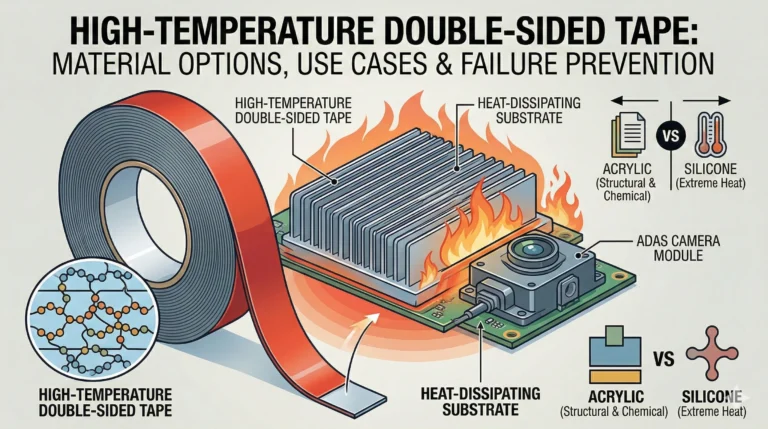
For thin double sided tape, the temperature range varies widely by construction. A PET carrier with a general-purpose acrylic adhesive may handle -20°C to 120°C. Specialized silicone adhesive systems extend the upper limit toward 200°C and beyond, but these are application-specific grades. The carrier itself — PET, tissue, or nonwoven — can also limit performance if it degrades before the adhesive does.
Acrylic foam tape, as supplied by ChenTao, operates across -20°C to 150°C in continuous service. The acrylic chemistry provides inherent resistance to UV degradation and oxidation, which matters for outdoor and under-hood applications where daily temperature swings put the bondline through repeated expansion-contraction cycles.
When thermal cycling is part of the service condition, the foam core provides a mechanical advantage that temperature ratings alone do not capture: it absorbs differential expansion between dissimilar substrates (e.g., aluminium bracket bonded to ABS plastic), reducing the peel stress that eventually lifts edges.
Adhesive Systems — When Each Works Best
Both tape categories commonly use pressure-sensitive acrylic adhesives, but the way the adhesive functions differs.
Thin double sided tape relies on near-perfect wet-out at the substrate interface. The adhesive layer is thin — typically 0.025–0.05 mm per side — which means there is little material available to flow into surface micro-texture. Any contamination, roughness, or low surface energy (LSE) substrate that prevents wet-out creates weak points. For LSE plastics (polypropylene, polyethylene), specialized adhesive formulations or surface treatments (corona, plasma, primer) are often necessary.
Acrylic foam tape brings more adhesive volume to the interface. The thicker adhesive-foam system has greater capacity to flow into surface irregularities under application pressure. Combined with the stress-distributing properties of the foam core, this makes acrylic foam tape the more dependable choice for painted metals, glass, and high surface energy plastics where long-term durability matters.
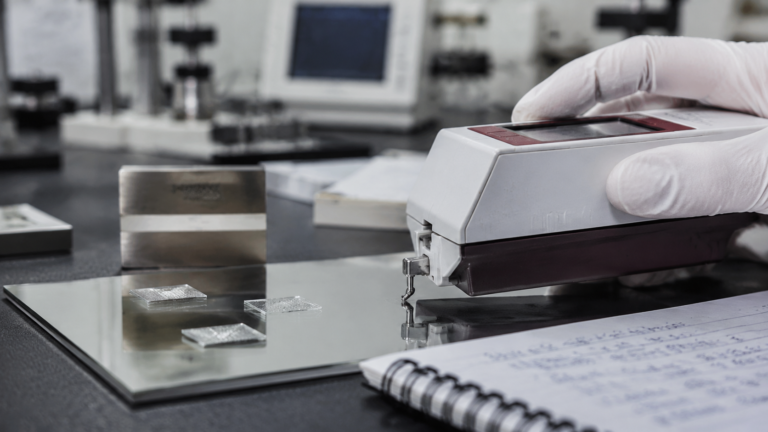
A practical rule: if you can control surface preparation, cleanliness, and application pressure to a high standard, thin tape can perform. If you cannot — or if the bond will experience uncontrolled environmental stress — acrylic foam tape is the safer starting point. For more on adhesive testing methods, refer to ASTM D3330 and PSTC test methods.
Cost & Availability Trade-offs
Thin double sided tape typically costs less per running metre because it uses less material. However, total applied cost includes converting (die-cutting, slitting, liner selection) and process yield. Complex shapes with tight tolerances can narrow or reverse the material-cost advantage.
Acrylic foam tape carries a higher unit price driven by material thickness and performance-grade acrylic formulation. The economics shift in its favour when the alternative — thin tape failure — leads to rework, warranty claims, or field recalls. For high-stress mounting applications, the per-joint cost difference is often negligible compared to the cost of a failed bond.
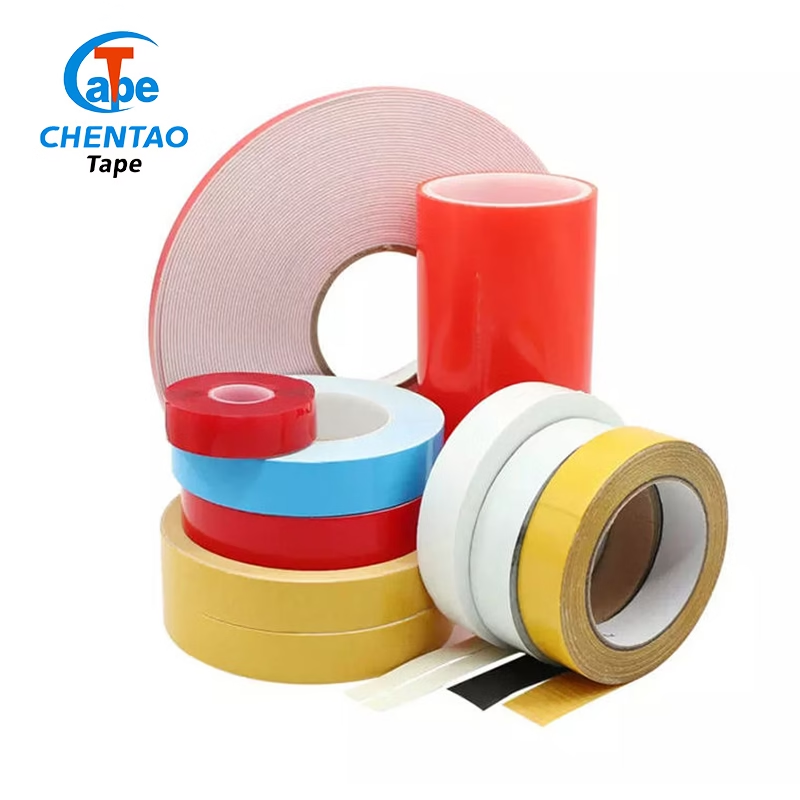
ChenTao supplies both categories from a single manufacturing site in Dongguan, China, with in-house acrylic, silicone, and custom adhesive compounding. This reduces the lead-time friction of sourcing from separate suppliers and allows technical teams to cross-reference recommendations across product families.
Application Scenarios
When to Choose Acrylic Foam Tape
Choose acrylic foam tape when the assembly faces one or more of these conditions:
When to Choose Thin Double Sided Tape
Choose thin double sided tape when precision and aesthetics drive the decision:
Sourcing Both Tape Types from One Manufacturer
ChenTao (cttape.com) is an ISO 9001:2015, ISO 14001, and ISO 45001 certified adhesive tape manufacturer based in Dongguan, China. The factory operates three adhesive systems in-house — acrylic, silicone, and custom formulations — covering both thin double coated tapes and acrylic foam tapes across a thickness range of 0.25 mm to 3.0 mm.
For engineering teams specifying both tape types in the same product (thin tape for interior bezels, foam tape for exterior trim, for example), sourcing from a single manufacturer simplifies quality documentation, reduces logistics overhead, and gives you one technical contact who understands the full assembly.
Standard service commitments:
Request a sample or discuss your specifications →
Frequently Asked Questions
Is acrylic foam tape always stronger than thin double sided tape?
No. Acrylic foam tape is more tolerant of joint movement, gaps, vibration, and thermal cycling because its viscoelastic foam core absorbs and distributes stress. Thin double sided tape can deliver very high bond strength on flat, well-mated surfaces in stable environments — especially when peel forces are controlled through joint design.
When should I use acrylic foam tape for automotive applications?
Use acrylic foam tape when the joint sees vibration, temperature cycling, or minor surface irregularity — all common in vehicle interiors and exteriors. Validate with an application-representative test that includes thermal cycling and vibration, not just a short-term pull test. Thin tape may work for static interior bezels; exterior trim almost always benefits from foam.
Why does tape lift at the edge even when the centre holds?
Edge lift is almost always peel-driven. Thermal expansion mismatch, vibration, or handling forces concentrate stress at the exposed bondline edge. Contributing factors include inadequate application pressure (poor wet-out), insufficient bond area, and contamination at the substrate surface. Acrylic foam tape reduces — but does not eliminate — this risk. Edge-aware design (adequate width, continuous bonding, avoiding sharp corners) matters regardless of tape type.
Can thin double sided tape fill gaps like acrylic foam tape?
No. Thin tapes have limited conformability — typically measured in microns, not millimetres. If your joint has steps, waviness, or textured coatings, a thin tape will bridge the high points and leave low points unbonded. Acrylic foam tape’s thicker, viscoelastic core is designed to conform and fill these irregularities while maintaining bond pressure across the full contact area.
What is the thickness range available for each type?
ChenTao supplies acrylic foam tape from 0.25 mm to 3.0 mm in thickness, covering applications from lightweight trim attachment to heavy panel mounting with significant gap compensation. Thin double sided and transfer tapes are available in thinner profiles — typically under 0.25 mm — with the exact range depending on carrier type and adhesive system. View the full acrylic double sided tape product page for current grade availability.
What does “VHB” mean and how does it relate to acrylic foam tape?
VHB (“Very High Bond”) is a trademarked product name owned by 3M for their line of acrylic foam tapes. The term is not a generic category, but has become common shorthand in industry for acrylic foam tape construction. When engineers ask about the comparison with double sided tape, they are really evaluating acrylic foam tape architecture against thin double coated or transfer tape architecture. The engineering principles in this guide apply to both branded and generic acrylic foam tapes — the structural difference (foam core vs. thin carrier) is what matters for joint performance.
Further Reading
Find the right tape for your application
Tell us what you need to bond, your operating conditions and the size or quantity you have in mind. Our team can help with material selection, samples and a quotation.
Discuss my application